Do the Math: De Blasio’s ‘Placard Crackdown’ Is Meaningless

The de Blasio administration is desperate to prove that the “placard crackdown” announced last spring is a real effort to stop illegal parking by police officers and other city employees, not a pantomime to distract from the mayor adding 50,000 traffic-generating, street-clogging placards to the city’s pool of parking perks.
Pressed by Fox 5 reporter Stacey Delikat earlier this week, de Blasio insisted that “we’re coming for anyone who violates the rules related to a placard.” And City Hall spokesperson Austin Finan told AMNY that placard violation fines increased from about 28,000 in 2016 to about 42,000 in 2017.
The 50 percent increase is meant to impress, but if you run the numbers, it’s clear that de Blasio isn’t doing much to disincentivize placard corruption.
There are now 160,000 official parking placards in circulation, after de Blasio’s giveaway to Department of Education employees last year. Let’s assume, conservatively, that only 4,000 of these placard holders — 2.5 percent — routinely use their parking perks to abuse the system and steal curb space.
Let’s also assume that the 42,000 tickets for placard violations all went to these 4,000 chronic abusers of the system, imposing a $115 parking fine each time. That would mean the placard cheats are paying, on average, $1,200 annually to park illegally. This is still a huge bargain in the NYC parking market.
Placard abuse tends to be concentrated in areas like Downtown Brooklyn and Lower Manhattan. The price of off-street parking in these neighborhoods runs to $300-$500 a month, or $3,600-$6,000 a year. Eating the cost of parking tickets under the purported “crackdown” is a steal compared to playing by the rules and paying for parking. Even with a few more fines, placard abuse pays.
In all likelihood, the placard fines are spread out over a far larger number of abusers, meaning the tickets are sending an even weaker signal.
Counting tickets is NYPD’s default method of measuring enforcement, but it doesn’t convey much. The numbers coming from City Hall tell us nothing about the incidence of illegal placard parking, where it’s a problem, or whether it is more or less prevalent than it was before the “crackdown” began.
That’s one reason why we launched our Street Cheats map. If the de Blasio administration is really getting placard holders to shape up, we should be able to see the difference on streets where placard abuse is a chronic problem.
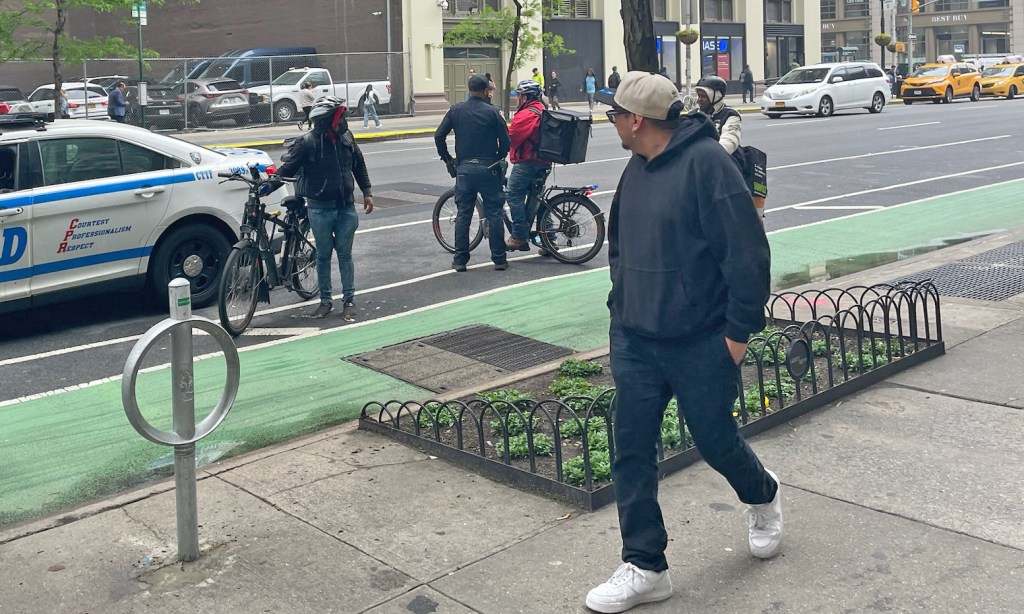
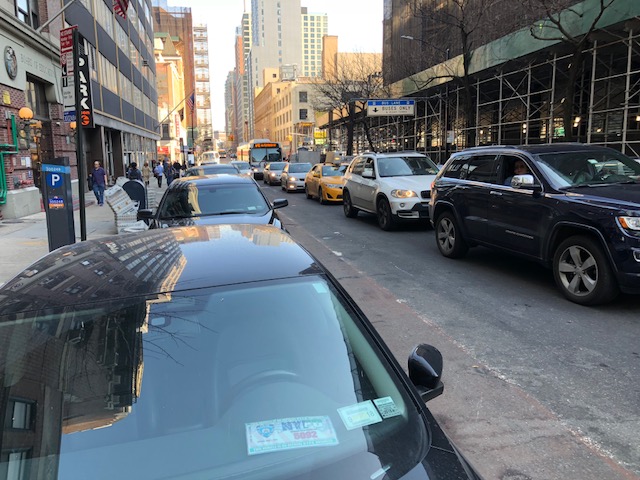
But the same placard abusers are monopolizing the Livingston Street bus lane, hogging the sidewalks of downtown Brooklyn, double-parking on the streets near the Bronx courthouses, and jamming the narrow streets of Lower Manhattan. There’s just no evidence that anything has changed.

Read More:
Streetsblog has migrated to a new comment system. New commenters can register directly in the comments section of any article. Returning commenters: your previous comments and display name have been preserved, but you'll need to reclaim your account by clicking "Forgot your password?" on the sign-in form, entering your email, and following the verification link to set a new password — this is required because passwords could not be carried over during the migration. For questions, contact tips@streetsblog.org.