Earth to U.S. DOT: Streets Succeed When They Do More Than Move Cars


What makes a street successful?
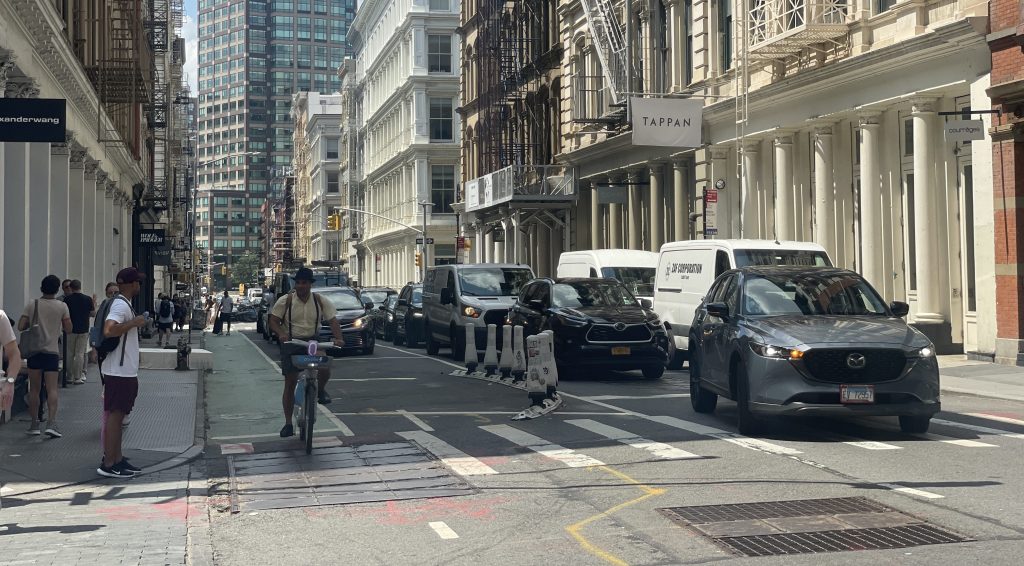
Does a street succeed when it’s economically productive, when it helps reduce carbon emissions, and when people can conveniently and safely get around using a variety of transportation modes, regardless of age, ability, or social status? Or does success boil down to moving as many cars as fast as possible?
The way public agencies answer these questions goes a long way toward determining what sort of streets our cities end up with. And that’s what’s at stake as U.S. DOT grapples with the question of how American transportation agencies should measure their performance. Unfortunately, the feds released a draft rule a few months ago that still emphasized the movement of cars above all.
Today Stephen Lee Davis at Transportation for America reports that local agencies and advocates from around the country have demanded a better standard from U.S. DOT — one that won’t subordinate people and cities to the movement of cars:
To develop a stronger alternative measure to submit to USDOT, SGA convened a working group of more than 30 local elected officials, state DOTs, metropolitan planning organizations (MPOs) and transit agencies, and national and state trade groups and advocacy organizations.
This work was supported by numerous state DOTs, MPOs, transit agencies and advocacy organizations; Oregon Metro (Portland) and Indy MPO; Trimet; Metro Atlanta Chamber and Indy Chamber; and the Transportation Equity Caucus, League of American Bicyclists, Safe Routes to School National Partnership, People for Bikes, PolicyLink, the Leadership Conference on Civil and Human Rights, Center for Neighborhood Technology and many others.
The coalition specifically requested the following changes to the final rule:
- Focus on the movement of people instead of only vehicles — the rule would treat a bus full of commuters the same as a single vehicle carrying one person;
- Remove the duplicative vehicle speed measures that provide marginal benefit;
- Provide a timeline for USDOT to implement an accessibility performance measure;
- Measure greenhouse gases (GHG) from the transportation sector, which represents the largest GHG emissions sector in the country; and
- Improve data sets to incorporate accurate roadway volumes, strategies to develop and implement safe and accessible multimodal networks, accessibility, and trip origin and destination.
In addition, a congressional delegation led by Senators Carper and Menendez in the Senate and Representative Blumenauer in the House also sent letters to USDOT Secretary Foxx requesting that USDOT assess the movement of people, rather than vehicles, as a better measure of congestion and also reward the improvements that can come from transit, toll lanes, or encouraging travelers to choose other options like walking or biking.
With a sitting president whose political base resides in cities and a transportation secretary well-versed in the harms of car-centric planning, U.S. DOT must be listening.
Elsewhere on the Network today: The Transport Politic looks at how transit agencies’ failure to cooperate undermines the interests of riders. And D Magazine says Dallas’s arterial street grid can be transformed from a weakness for walkability to a strength.

Read More:
Streetsblog has migrated to a new comment system. New commenters can register directly in the comments section of any article. Returning commenters: your previous comments and display name have been preserved, but you'll need to reclaim your account by clicking "Forgot your password?" on the sign-in form, entering your email, and following the verification link to set a new password — this is required because passwords could not be carried over during the migration. For questions, contact tips@streetsblog.org.