Feds to Traffic Engineers: Use Our Money to Build Protected Bike Lanes

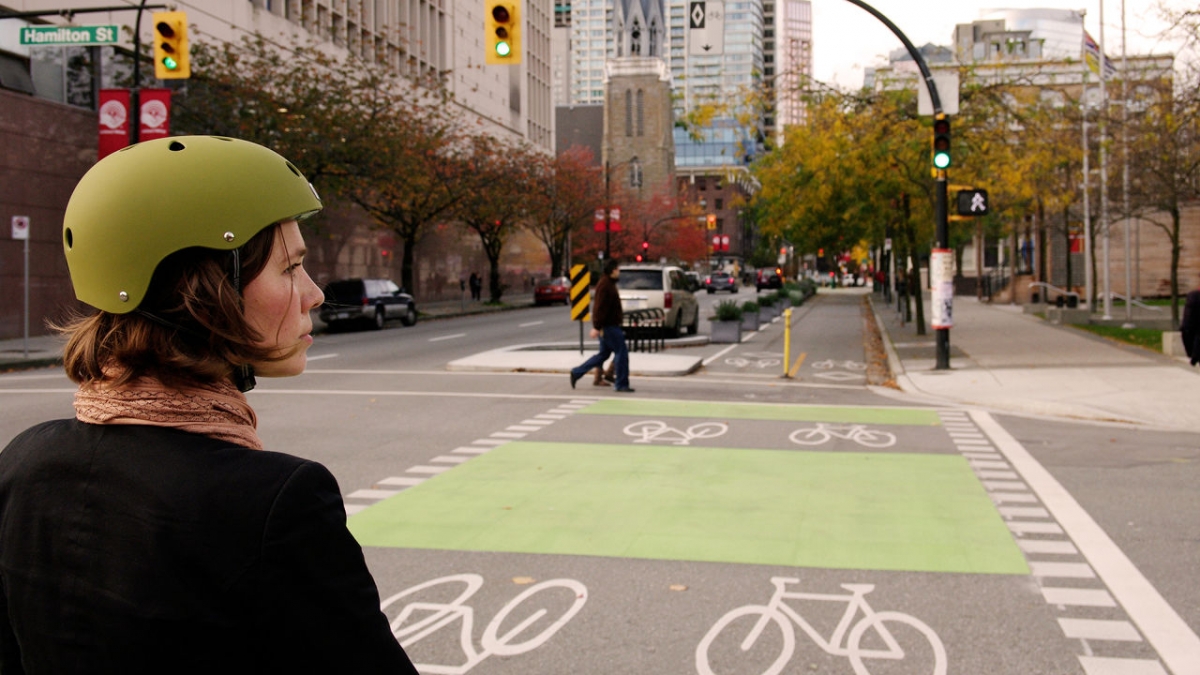
The Federal Highway Administration wants to clear the air: Yes, state and local transportation agencies should use federal money to construct high-quality biking and walking infrastructure.
State and local DOTs deploy an array of excuses to avoid building designs like protected bike lanes. “It’s not in the manual” is a favorite. So is “the feds won’t fund that.”
Whether these excuses are cynical or sincere, FHWA wants you to know that they’re bogus.
Last week, the agency released a “clarifying” document that shoots down, on the record, some of the common refrains people hear from their DOT when they ask for safer street designs. This is a good document to print out and take to the next public meeting where you expect a transportation engineer might try the old “my-hands-are-tied” routine.
Here are the seven things FHWA wants to be absolutely clear about:
1. Federal funds CAN be used to build protected bike lanes.
In case any doubt remains, FHWA printed its own design guide for protected bike lanes. It’s okay to use federal money to build them.
2. Federal funds CAN be used for road diets.
FHWA created a whole website to help states and municipalities implement road diets that reduce lanes for motor vehicle traffic to improve safety. FHWA wants local agencies that federal money can be used on them.
3. Engineers are allowed to use design guides other than the AASHTO Green Book for projects that receive federal funds.
The AASHTO Green Book — published by the association of state DOTs — is a behemoth, but its crusty old street design standards aren’t the only game in town. The protected bike lane templates in the design guide published by the National Association of City Transportation Officials are totally kosher. Go ahead and use them. FHWA says it supports a “flexible approach to the planning and design of bike and pedestrian facilities.” That means “It’s not in the Green Book, so we can’t do it” isn’t a valid excuse.
Peter Koonce, a transportation engineer with the City of Portland, said this clarification should make designing quality bike infrastructure easier.
“Agencies like ours occasionally encounter resistance to the use of treatments in the NACTO Urban Bikeway Design Guide, the FHWA Separated Bike Lane Guide, or other Guidance documents from reviewing agencies [] because there is a lack of familiarity with new treatments, thus a difficulty to apply engineering judgment,” he said. “An example of this is bicycle traffic signals.”
4. “Highway” funding CAN be used for bike and pedestrian infrastructure.
It’s not only the Transportation Alternatives Program that can be used to fund bike and pedestrian infrastructure, FHWA says. Many other sources of federal funding can be used to support safer biking and walking in the right circumstances, including funds from the huge pot in the Surface Transportation Program.
5. Vehicle lanes DON’T have to be a certain width to receive federal funds.
No, lanes don’t have to be at least 11 feet wide on the National Highway System or at least nine feet wide on local roads. According to FHWA: “There is no minimum lane width requirement to be eligible for Federal funding.”
FHWA refers to blanket adherence to typical lane-width standards as “nominal safety,” but using engineering judgment based on the particular circumstances as “substantive safety,” urging engineers to practice the latter.
Also: “In appropriate contexts, narrower lanes, combined with other features associated with them, can be marginally safer than wider lanes.”
6. Curb extensions, roundabouts, and trees CAN be used on streets in the National Highway System.
“There is no prohibition on incorporating these features on NHS projects,” FHWA says. “Curb extensions, also known as bulbouts or neckdowns, can have significant benefits for pedestrian safety.”
7. Speed limits DO NOT need to be set using average vehicle speed.
Another common myth the FHWA addresses is the idea that the speed limit for federally funded roads must be set using the “85th percentile” rule — which means that the limit is based on the speed that the fastest 15 percent of drivers exceed on a road. FHWA calls the 85th Percentile rule “just one part” of an approach that should consider other factors like pedestrian traffic. FHWA has its own tool for calculating appropriate speed limits.

Read More:
Streetsblog has migrated to a new comment system. New commenters can register directly in the comments section of any article. Returning commenters: your previous comments and display name have been preserved, but you'll need to reclaim your account by clicking "Forgot your password?" on the sign-in form, entering your email, and following the verification link to set a new password — this is required because passwords could not be carried over during the migration. For questions, contact tips@streetsblog.org.