Lieutenant Governor Richard Ravitch opens his new report on transportation funding in his characteristically blunt fashion:
"New York State currently lacks the revenues necessary to maintain its transportation system in a state of good repair, and the State has no credible strategy for meeting future needs."
It doesn't get any cheerier from there.
Faced with aging infrastructure and saddled with billions in debt, both the MTA and the State DOT are staring down impossible deficits. Without billions more dollars over the next few years, New York will watch as its trains begin to grind to a halt and its bridges collapse. A crisis of that scale demands similarly aggressive solutions, and Ravitch pulls no punches. He calls for not only tolls on the bridges into Manhattan, but on all major bridges and highways in the state, as well as special tax districts for particular mega-projects and potentially controversial reforms to the planning process.
Ravitch starts by laying out just how bankrupt the state's transportation system really is. The MTA, of course, has a $10 billion deficit in its $28 billion capital plan over the next three years.
Over at the DOT, the current capital plan is already so shorn back that it only repaves or reconstructs 2,000 lane miles a year, when it would need to repair 3,500 each year just to stay in a state of good repair. For it to meet that modest goal, the DOT needs at least another $8 billion.
Taking out the bonds to pay for those capital plans would require $600 million in new revenue for the DOT and $700 million for the MTA each year, according to Ravitch's estimates.
It's worth following Ravitch into the depths of each budget crisis, to understand how things have gone so awry. The chief culprits: irresponsible borrowing and dangerous budget gimmickry.
"Between 2000 and 2008, the MTA nearly doubled its debt burden from $13 billion to $24 billion," writes Ravitch. Not only didn't the state find the revenue for that borrowing, it backloaded the bonds, adding to the total cost in order to push back payments into the 2020s and 2030s.
DOT's position might be even more perilous. All capital spending is supposed to be paid for out of the Dedicated Highway and Bridge Trust Fund, formed in 1991 for that purpose. The dedicated fund's revenues currently add up to around $2 billion each year. Of that, $1.3 billion will be spent on debt service and just under $1 billion will be spent on administrative costs and operating expenses like snow and ice removal. "Paying out these amounts will consume almost all of the available revenues in the Fund before any new capital work is accounted for," writes Ravitch.
In fact, DOT has only been kept afloat by massive infusions of cash from the state's general fund. "In the current year, SFY 2010-11, despite New York’s enormous budget deficit, the State budget transferred $700 million into the Dedicated Fund," writes Ravitch.
At the same time, the state has been skimming money from the MTA into the general fund, a point which Ravitch doesn't mention at all. That happens both through outright raids on MTA dedicated funds, like the $143 million that Albany stole from the MTA last December, and through budget tricks like paying the state's 18b general fund obligations with dedicated funds, which costs the MTA over $150 million annually. Essentially, Albany appropriates dedicated transit funds to pay for roads.
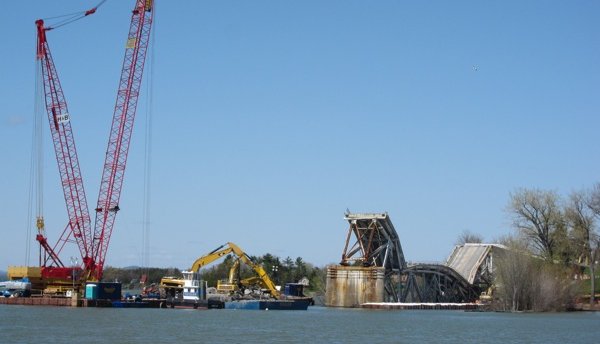
Having dug this ditch, however, Ravitch argues there's essentially no way for the state to get out of those costs. Unless it finds the funds, New York is going to see more repeats of last year's Crown Point Bridge fiasco, in which a bridge across Lake Champlain had to be closed for safety reasons, forcing those who would use it on a 100-mile detour. Ravitch says that can't be allowed to happen on the rapidly deteriorating Tappan Zee or Kosciuszko Bridges, which will cost $6-10 billion and $1 billion to replace, respectively.
The big transit expansions can't realistically be cancelled either. If New York cancelled the Second Avenue Subway and East Side Access, it would have to repay over $1.5 billion to the feds. Chris Christie would look fiscally prudent in comparison. That means that basic repairs would get the axe, "gravely impairing the condition of the State’s transportation infrastructure system," in Ravitch's words, which he called "unacceptable."
That leaves the state without many options. Ravitch presents a few strategies to keep costs down in the future. He suggests relaxing the environmental review process for projects that can be assumed to be green, like transit or rail, and changing state law to allow the same contractor to design and build a single project. He also suggests that both DOT and the MTA need to work more closely with other agencies to implement smart growth-style development that would allow the same infrastructure to serve more people.
At the end of the day, however, Ravitch argues it comes down to revenue, and lots of it. No longer is Ravitch calling for tolls just on the East and Harlem River bridges. Now he wants a "coordinated regional tolling strategy that includes all key bridges and statewide roads, especially the parkway system." Ravitch also proposes creating special taxing districts where particular mega-projects would concentrate benefits in a certain area.
Now all that remains is to assemble the political coalition for tolling every important road in the state...