Congestion Pricing: Does New York Have the Will?


Brad Aaron reports:
Political will, holistic planning, centralized management. That’s
what Malcolm Murray-Clark says it takes to implement an effective
congestion pricing plan.
He should know. The Director of Congestion Charging at Transport for London (TfL) oversees a program that is as ambitious as it is successful — a
program that went from idea to implementation in just 26 months,
significantly reducing traffic and pollution while earning approval
ratings as high as 59 percent.
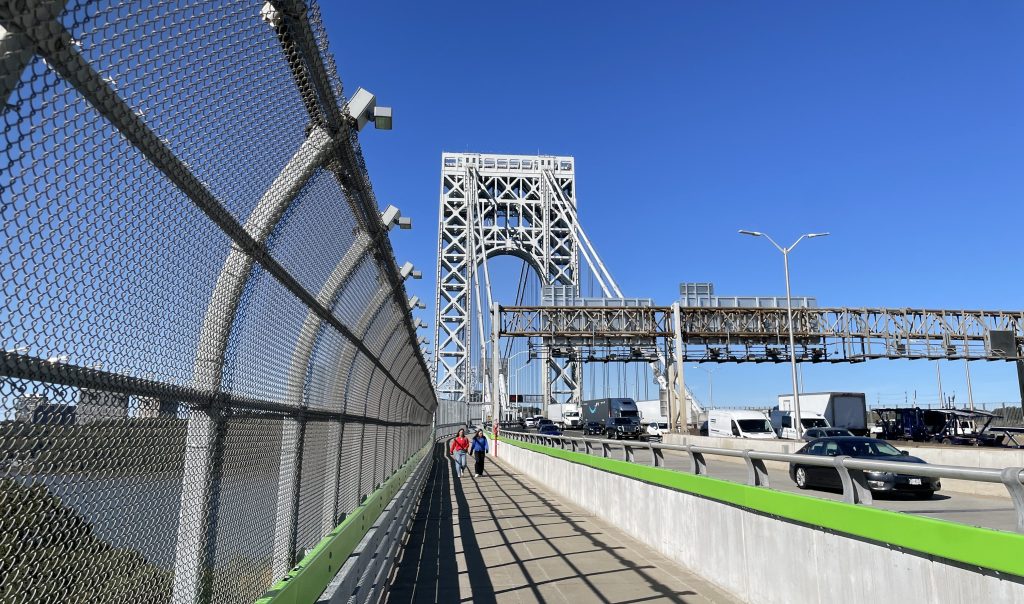
As cars and trucks clogged the arteries of lower Manhattan on their
way out of the central business district yesterday evening (right),
Murray-Clark held forth to a capacity crowd at 7 World Trade Center.
Sponsored by the New York Academy of Sciences,
the lecture also featured Stephen A. Hammer of Columbia University and
CUNY’s Dr. Robert “Buzz” Paaswell, director of the University
Transportation Research Center and former executive director of the
Chicago Transit Authority.
From the start, Murray-Clark said, London Mayor Ken Livingstone
pulled no punches regarding his intention to reduce auto traffic. In
fact, Livingstone ran on a platform that included congestion pricing.
And upon taking office in 2000, he got to work. Today, London is one of two major world cities experiencing a reduction in car trips (Paris is the other).
“It was a bold policy to embark upon,” Murray-Clark
said, and one that proceeded through a combination of thoughtful
planning and shrewd political maneuvering. Rather than wait years for
upgrades to London’s already overcrowded subway system, for example,
TfL leveraged congestion pricing revenue to invest heavily in new
buses. In order to ease opposition in the early stages, Livingstone
offered a 90 percent discount for residents of the congestion zone, and
courted the trucking industry by offering it the same rate per vehicle
as passenger cars.

Despite early skepticism
and a highly critical media, Londoners warmed to congestion pricing
shortly after it took effect. Livingstone has since won re-election
once, and though he is up again next year, he has a series of
more radical environmental proposals, like reducing — or even
eliminating — charges for low CO2 cars while raising the fee for
high-emission vehicles like SUVs to the equivalent of $48 per entry.
“his was announced, and there was no uproar,” Murray-Clark said. “This is where Londoners are at the moment.”
Still, congestion pricing remains “contentious and newsworthy,”
he said, and support fluctuates depending on fluid circumstances.
Anxiety over a recent expansion of the zone caused approval ratings to dip, while new transit investments normally rate an uptick.
“This isn’t a panacea,” said Murray-Clark. “This isn’t something
you do on its own. This is something you do as part of a wider package.”
The package — more buses, effective traffic management inside and
outside the zone, reliable monitoring technology, a convenient payment
system, and steep fines for non-compliance — was possible in large
part because London transportation planners and transit officials work
for the same agency, an advantage New York doesn’t have. Another
obstacle is New York’s culture,” according to Paaswell.
“Congestion pricing is like the Second Avenue subway,” Paaswell
said. “We’ve been talking about it a long time, and it isn’t here.”
The most significant issue New York needs to overcome, said Paaswell, is that of leadership, both political and bureaucratic. Who
would collect congestion fees? Who would allocate them? Would a new
authority be needed? Who will make these decisions? In short, read a
PowerPoint slide beamed behind the panel: WHO IS IN CHARGE??
In Murray-Clark’s experience, someone has to be.
“A referendum,” he said, “probably is a basis for doing nothing.”
NYC photo: Brad Aaron
London photo: Aaron Naparstek

Read More:
Streetsblog has migrated to a new comment system. New commenters can register directly in the comments section of any article. Returning commenters: your previous comments and display name have been preserved, but you'll need to reclaim your account by clicking "Forgot your password?" on the sign-in form, entering your email, and following the verification link to set a new password — this is required because passwords could not be carried over during the migration. For questions, contact tips@streetsblog.org.