Report: NYPD’s Dangerous Increase In High-Speed Pursuits Did Not Decrease Crime
The NYPD’s decision to increase high-speed vehicle pursuits under Mayor Eric Adams led to more crashes, injuries and deaths — and didn’t even drive down crime, according to a new study.
The department increased its pursuits 25-fold in 2022, as Streetsblog previously reported, from around eight pursuits per month to 200. The increase had no tangible impact on crime beyond larger national trends — but it did cause roughly 675 more collisions, 355 additional injuries and seven additional fatalities, according to the researchers.
“It’s a lot of innocent lives,” said Justin Nix, a professor at the University of Nebraska at Omaha and co-author of the study, “The Fast and the Spurious — A Causal Evaluation of NYPD’s Pursuit Policy, 2022–2025.”
“One-third of the people who are getting injured or killed are other people — drivers, pedestrians — who didn’t even decide to flee [police].”
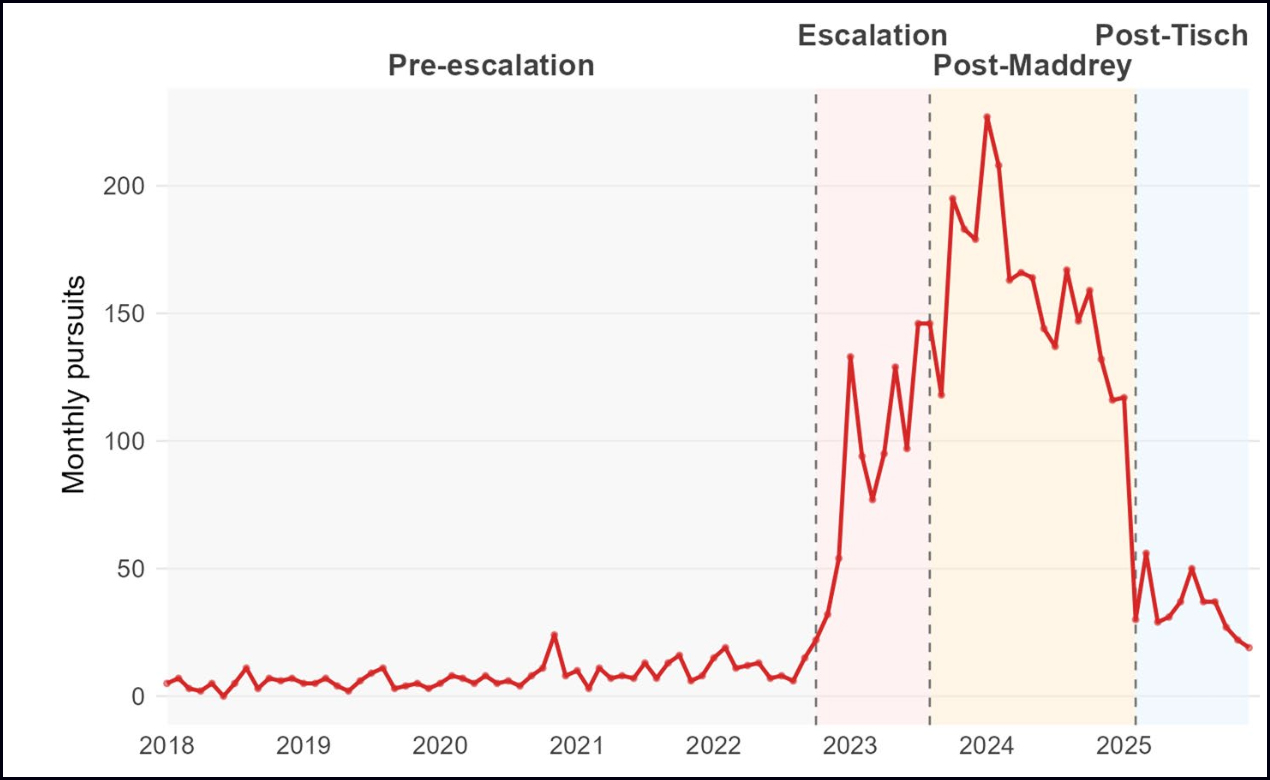
The researchers used city crime statistics to look at the effects of the increase, and subsequent decrease, in pursuits. They focused on three specific categories of crimes — collisions, robberies and gun violence — while factoring in national trends. Their analysis found one immediate effect: crashes increased and then decreased, as did resulting injuries and deaths, based on changes in agency policy.
But the researchers saw no noticeable changes in robberies and gun violence.
“Pursuit escalation produced clear and attributable collision harms while providing no credible evidence of crime reduction,” Nix wrote with his co-author John Hall.
The researchers used a value-of-life analysis — a common, if macabre, method of criminological data analysis that essentially puts a price tag on injuries, deaths and property damage – to calculate at what point the toll of increased pursuits would be mitigated by decreases in crime.
Ultimately, they found that New York’s crime levels were nowhere near the level needed for the new pursuit policies to justify the overwhelming costs in terms of collisions, injuries and deaths. Instead, they found that the NYPD unleashed costly harms on city residents in exchange for purely imaginary crime-reduction benefits — in other words, the top brass’s decision to increase these pursuits came at a shocking net loss to public safety.
“Agencies should require affirmative evidence of crime-prevention benefits before expanding pursuit authority,” the authors wrote in implicit criticism of the NYPD after studying their actions from 2022 to 2025.
The study noted that the initial decision to increase pursuits was made unofficially, seemingly in late 2022.
“People thinking they can take off on us? Those days are over,” Chief of Department John Chell told reporters at the time — an indication that he had ordered his cops to be more aggressive with their cars.
By August 2023, then-Chief of Department Jeffrey Maddrey released a memo formalizing the department’s pursuit policy, which remained just vague enough to maintain the Chell-initiated trend: pursuits could continue for non-violent crimes, but they should be terminated when “the risks to uniformed members of the service and the public outweigh the danger to the community if suspect is not immediately apprehended.”
Police leaders across the country often argue that pursuits serve as a crime deterrent. But previous research has found that roughly 30 percent of police pursuits end without a successful apprehension. And suspects choosing to flee police are overwhelmingly young, male, intoxicated and unlicensed — characteristics associated with a “weakened deterrence perception” and “impaired risk assessment.”
Under fire as chases rose dramatically under Chell and Maddrey, the NYPD revealed in 2024 that around two-thirds of its pursuits began as simple car stops for traffic offenses — and 25 percent of the 2,278 chases “resulted in some combination of a collision, property damage, or physical harm,” the NYPD told Streetsblog.
Around a dozen of the pursuits resulted in fatalities — including Amanda Servedio, who was killed in Astoria in 2024 by a driver who was not suspected of a violent crime fled the cops.
Commissioner Jessica Tisch reversed the Chell-Maddrey initiative and codified NYPD policy in 2025, restricting chases to serious crimes, discouraging pursuits near schools and playgrounds and shielding cops from criticism or discipline if they chose to terminate a pursuit because of safety concerns. The department’s pursuit numbers quickly declined, though they remain slightly higher than where they were before the 2022 escalation.
Nix noted that this quick reversal was abnormal, and it allowed researchers to study how pursuits affected crime numbers both as pursuit numbers went up and as they came back down — making the statistically significant changes in crashes, and the lack of change in crime numbers, even more apparent.
“If we observed an effect,” Nix said, “we would obviously expect to see the opposite when the policy changed again.”
The NYPD did not respond to multiple messages seeking comment for this story.