Rogue Delivery App Motoclick Is ‘Subverting’ Minimum Pay Law — And Admitting It
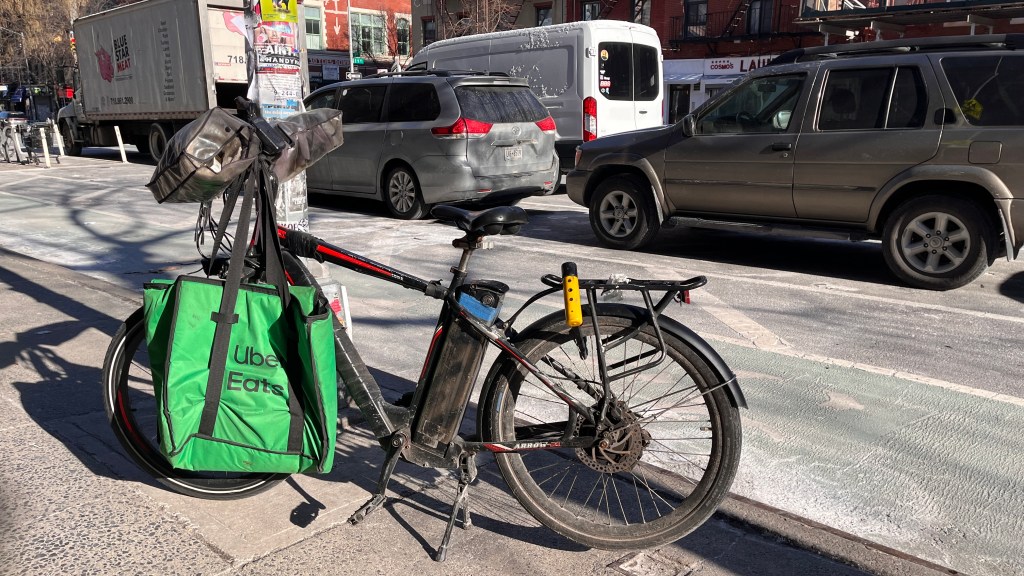
It’s a new game of Whack-a-Mole.
Large delivery app companies and middle men are subverting the hard-won delivery worker minimum wage by paying a rogue app to make deliveries, the company’s lawyers admitted in court this week.
The city sued the business-to-business app, Motoclick in federal court in January for failing to pay the delivery worker minimum wage. The app, according to its own court filings, does not think it should have to pay workers for “on call time,” and therefore doesn’t. But city rules have required app companies to pay workers for on call time since 2023. Apps must pay workers $22.13 per hour for the time between pickup and delivery, plus an additional amount for on-call time that’s calculated based the total time workers spend waiting for orders.
The company’s reports to the city show that it paid workers as little as between $3.67 and $4.67 per hour in May, the Department of Consumer and Worker Protection alleges in its lawsuit. At a court hearing on Thursday, Motoclick’s lawyers admitted to not paying workers for their on call time and said that 90 percent of their business comes from “overflow” from the big apps – the company specifically mentioned UberEats and DoorDash. Motoclick gets those delivery assignments via a third-party marketplace.
“Motoclick admits that it does not pay for on-call time, it is brazenly violating the minimum pay law,” DCWP Deputy Commissioner Elizabeth Wagoner told Streetsblog after the hearing. “We are hopeful the court will issue an injunction so Motoclick can no longer subcontract orders from larger apps who are benefitting from Motoclick’s illegal conduct.”
The alleged subcontracting raises more questions than answers. Uber, DoorDash and Grubhub denied having any contractual relationship with Motoclick. Uber said that other middleman companies could be facilitating the relationship indirectly without Uber’s knowledge.
“Some merchants that use Uber Eats choose to arrange their own delivery fulfillment rather than use Uber’s network of delivery workers,” said company spokesman Josh Gold. “Those merchants may use third-party delivery orchestration services, such as Cartwheel or Shipday, which route deliveries to independent logistics providers. If Motoclick fulfilled Uber Eats orders, it may have done so through one of those merchant-selected orchestration services, not through a direct relationship with Uber.”
And DoorDash said it is against policy for a third party to make deliveries placed through its platform.
“If a restaurant on our platform were to use a third party for delivery, like Motoclick, they would be in violation of our terms and conditions, which we strictly enforce,” said company spokesperson Samantha Ramirez. “Any restaurant found to be violating contract terms faces a potential removal from our platform.”
Still, Motoclick’s Chief Marketing Officer, Alan Chaparro, alleges in court filings that customers can place an order through a major delivery app and a Motoclick worker could show up.
“Other companies in the restaurant delivery industry will use a third-party marketplace to hire Motoclick to complete specific restaurant deliveries when it makes more sense economically not to dispatch one of its own workers, based upon factors such as availability of a delivery worker being close by,” the filing reads. “Over 90 percent of our revenue comes from handling overflow deliveries for the dominant platforms such as DoorDash and Uber Eats.”
Gold says this is because when a restaurant selects a middleman company to do deliveries both the customer and the other delivery app companies are in the dark.
“[A merchant can] select a middleman who picks the best delivery option for them in real time. So, yes, the restaurant doesn’t know. Nor do we. In fact, we are also trying to secure deliveries from some of those companies because we want the work and it harms us when companies like Motoclick are subverting the market and taking work from us,” he said in an email.
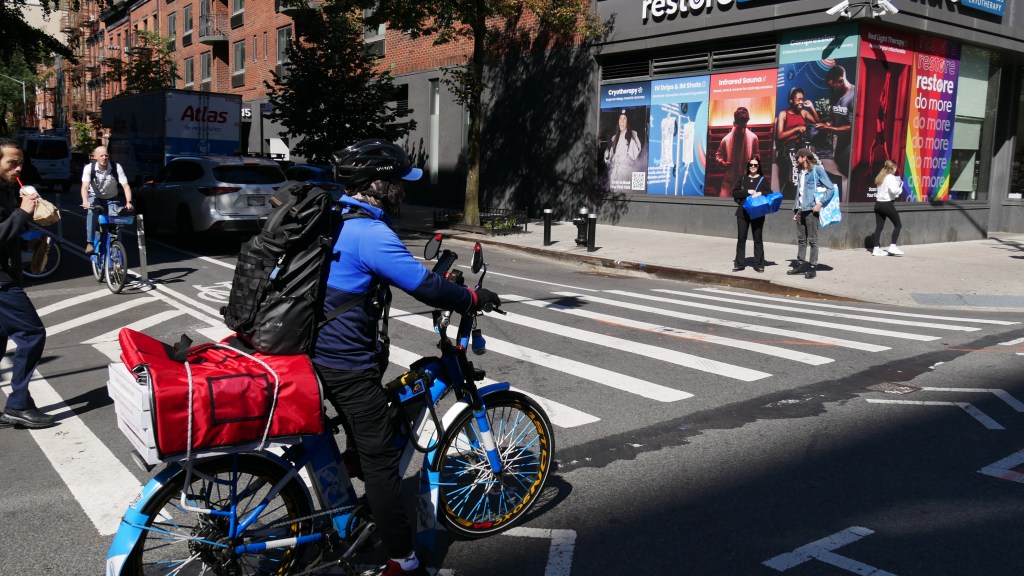
The city began investigating Motoclick in February 2024 after receiving complaints about violations of the minimum wage laws from over 20 workers. Thursday’s court proceedings lasted around five hours and consisted of cross examination of an anonymous delivery worker, who is a plaintiff in the case, and DCWP economist Michael Papadopoulos.
The most interesting revelations were about Motoclick’s business model, which the city claims “subverts” the minimum wage law, which successfully raised take-home pay for workers.
“So long as apps have an option to subcontract to workers getting underpaid, that will incentivize Motoclick’s marketshare to grow,” John De Vito, senior enforcement counsel at DCWP, testified. “Every order that goes to Motoclick is not going to a DoorDash worker or an Uber Eats worker. They are subverting the entire market. We can’t even estimate the harm.”
Motoclick claims that it comprises just 2 percent of the entire delivery market in New York City, but the revelation of the middleman scheme could have huge consequences for the pay standard. When Relay, another business to business app that has since shuttered operations in NYC, was exempt from the pay standard in 2024, it led to a vast subcontracting scheme by Grubhub, a Streetsblog investigation revealed.
When one company is held to a different standard it degrades conditions for all workers, one expert said.
“That practice would clearly undermine the viability of the pay standard and would also erode the pay and the working conditions of the workers on the larger apps,” said James Parrott, a senior fellow at the Center for New York City Affairs at The New School. “It’s only a matter of time that the whole industry would be dragged down.”
Wagoner and the city’s legal team went into the hearing convinced that it would win an injunction, which gives Motoclick the option to either come into compliance or shut down, sources in the Department told Streetsblog. But federal Magistrate Judge Stewart Aaron is waiting to rule on the requested injunction until after Aug. 5, when Motoclick’s Chaparro will appear for cross examination.
“It’s not like Motoclick is an addiction they can’t quit,” Aaron said of the workers choosing to sign up and work for the app. “They can just stop doing deliveries. You’re asking to basically shut [Motoclick] down, which would have the effect of a win.”

Streetsblog has migrated to a new comment system. New commenters can register directly in the comments section of any article. Returning commenters: your previous comments and display name have been preserved, but you'll need to reclaim your account by clicking "Forgot your password?" on the sign-in form, entering your email, and following the verification link to set a new password — this is required because passwords could not be carried over during the migration. For questions, contact tips@streetsblog.org.