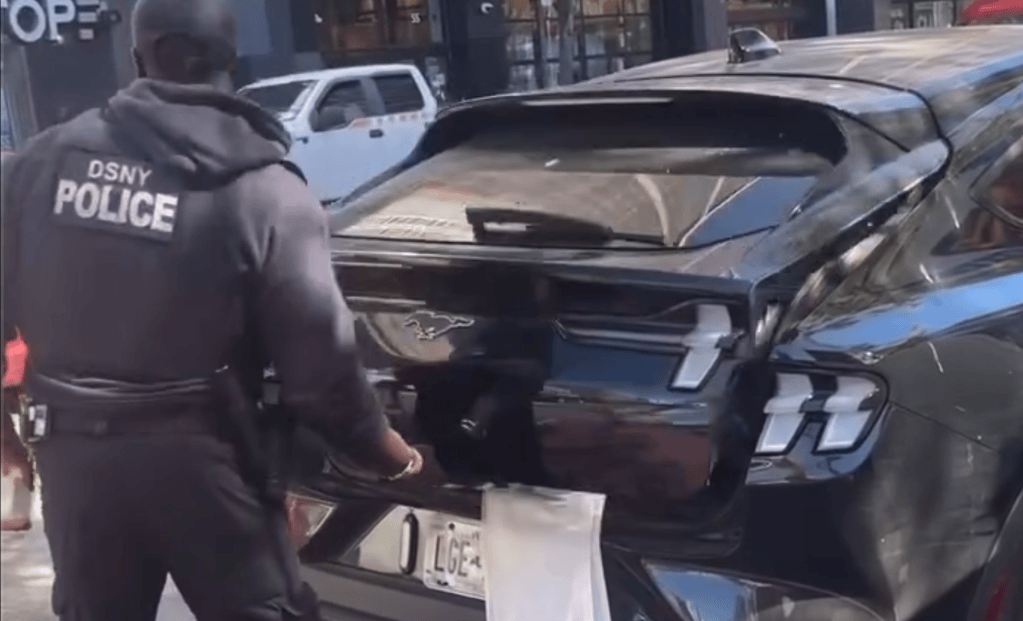
New York’s Rampant Illegal Parking Stumps Viral Good Samaritan Street Cleaners
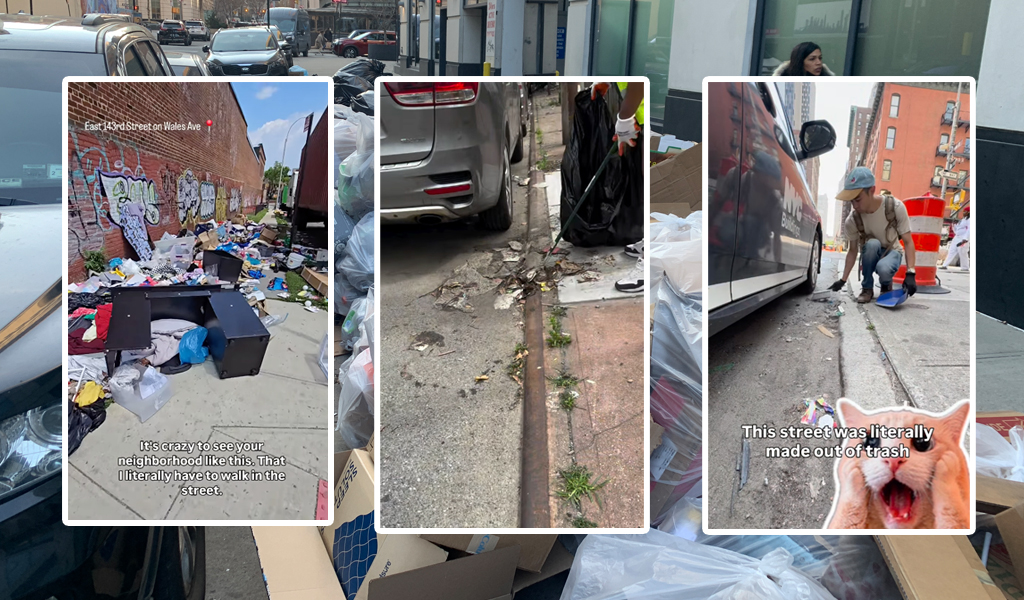
Drivers who don’t move their parked cars for street cleaning are getting in the way of New York City’s viral new hobby: picking up trash.
Even a state Assembly Member is following the trend, and complaining about scofflaws who refuse to move their cars when the Department of Sanitation drives street sweepers down their block.
“The amount of garbage under this car lets me know that this car does not move,” said Assembly Member Chantel Jackson (D-East Tremont) in an Instagram video documenting her neighborhood cleanup on June 27. Jackson’s camera panned to a black sedan with trash caked around each wheel.
“They have not been able to clean this street, so let’s get this done,” Jackson narrated before using her trash picker and broom to try to clean the accumulated litter. “I don’t see any tickets on it, so I’m really not sure what the situation is with this car, if it’s abandoned or if the ticket agent is just skipping this one. I tried to clean it as much as I could but it’s really better if the cars move to get this done.”
Facts on the ground
Ninety-seven percent of New York City’s street parking is completely free. All the city asks of drivers is that they move their cars a few times a week for approximately 90 minutes so that DSNY’s street sweepers can vacuum up debris.
This arrangement has firmly lodged itself in city folklore. New Yorkers romanticize the “street-cleaning shuffle,” in which motorists wait in double-parked cars until sweepers come through and then quickly reclaim their parking spot. Documentary filmmaker Jon Wilson devoted an entire episode of his popular HBO series “How To” to the practice.
In reality, free street parking encourages drivers to use the public curb as long-term car storage. The city’s meager fine for failing to move for the street sweepers — just $65 — is far less than the cost of a dedicated garage. Drivers leave their cars on the street and gladly pay the fines because parking in a garage is oftentimes far more expensive. This allows trash to accumulate underneath cars, adding to the buildup of filth in the city.
“I think there’s some deep problems in the system, and I do think that tickets would have to [increase] if the city actually wants the behavior to be changed,” said David Clarke, who grew his Instagram account @TrashTalkNYC to 45,000 followers in just 48 days by posting a daily video cleaning up city streets with little more than a picker and a broom.
Based on his experience cleaning streets across the city, Clarke said the city’s official street cleaning system doesn’t work at all. On his block on 171st Street, he has never once seen the street sweeper make it down without any cars in the way.
“On my street, the street sweeper only makes it to the curb once every ten times,” he told Streetsblog. “I have strong feelings about it, because to me, at that point, you might as well just have someone with a broom come through. Like, why are we paying for a system that we can’t use?”
Clarke recently began using a car to transport gear for his volunteer meetups. Looking for parking in a safe lot revealed the financial pressures at play.
“The tickets have to be proportional to the cost of parking in the area,” Clarke said of current alternate-side parking penalties. A local garage asked him to pay $400 per month to park his new ride. From his close observations of his block, he estimates he would get a $65 ticket around twice a month if he left it on the street for free — far less than the monthly garage rent.
“The city is just occasionally enforcing tickets, but not really solving the problem,” he said.
Put a sticker on it
Both DSNY and the NYPD can ticket cars for staying put during street cleaning. NYPD issues around 1.5 million tickets per year, while DSNY issues around 500,000 per year, according to DSNY.
Some lawmakers want the city to adopt a more confrontational approach when discouraging drivers from blocking street sweepers. The city council recently passed a bill, sponsored by Council Member Gale Brewer (D-Upper West Side), that reinstates the practice of applying hard-to-remove stickers on the windows of law-breakers’ precious vehicles.
In May, the City Council passed a resolution that called on Albany to allow the city to install automated enforcement cameras on street sweeper vehicles. Under the relevant legislation, S1891A, those cameras would catch the license plates of cars blocking the way and issue a ticket automatically. The pending bill, sponsored by state Senator Robert Jackson (D-Upper Manhattan) and heralded by DSNY, cleared the State Senate in early June but didn’t get a vote in the State Assembly before the year’s legislative session ended.
In the absence of effective enforcement, DSNY has resorted to public shaming. Beyond the resurrected stickers, the department publishes a “Hall of Shame” of “Sidewalk Slobs” — the agency’s term for property owners and businesses who neglect to keep the sidewalk outside their buildings clean, as required by law.
After all, the department told Streetsblog the city doesn’t give out enough tickets to deter the practice. Under two million parkers are ticketed per year for not moving their cars, but you probably don’t remember the last time you walked down an entirely compliant block.
“Nearly 500,000 car owners disregard street cleaning regulations every week, keeping us from cleaning more than 3,000 miles of streets,” DSNY Commissioner Gregory Anderson said in a statement. “Our goal here is not to issue more summonses, but to send a message that if you decide that your convenience is more important than clean neighborhoods, then yes, you will receive a summons. And if Albany lets us send that message loudly and clearly to all neighborhoods, people will finally start to move their cars. We don’t want to issue summonses — we just want to clean the streets.”
Fill a government vacuum
DSNY has a complicated relationship with do-gooders like Clarke and Assembly Member Jackson, in part due to burdensome bureaucratic process that requires official city approval for volunteer clean-ups.
To officially organize a street clean-up in NYC, volunteers must plan it at least two weeks in advance. The department only approves clean-ups on streets and sidewalks, not in other public places like parks or beaches. The organized clean-ups are intended for the department to share supplies, but New York’s Strongest won’t stop people like Clarke from venturing out on their own, the agency said.
However, trash pickers still risk fines if they leave bagged trash in the wrong spot. DSNY recently established a rule that forbids any entity that cleans the streets — including business improvement districts and neighborhood associations, but also random groups of volunteers — from placing “any amount of refuse or recycling next to or against any public litter basket.”
“They make it very difficult for grassroots efforts,” said Samantha MacBride, who worked at DSNY for nearly 20 years in sustainable waste management and now teaches at Baruch College’s Marxe School of Public and International Affairs. “The type of spontaneous community groups, like this sort of newest generation, that doesn’t work for [DSNY], because it’s very bureaucratic.”
MacBride works in an academic field known as Discard Studies, which examines and critiques popular assumptions about waste, including those related to volunteers who pick up litter.
“Even though I critique individualizing environmental problems in the area of recycling, with litter it’s different, because it is very close to actual individual behavior and individual daily life and individual outcomes,” she said, adding that social media accounts like Clarke’s “really show the ingenuity and how much further ahead socially and technologically these groups are than large city agencies.”
But for all the positives, MacBride cautioned against an outcome where people are picking up the government’s slack.
“When any type of voluntary effort starts to substitute for basic provision of services,” she said, “there is reason to be concerned.”
Correction: An earlier this story incorrectly stated that Clarke had used his GoFundMe money to purchase a car. He already owned the car.

Read More:
Streetsblog has migrated to a new comment system. New commenters can register directly in the comments section of any article. Returning commenters: your previous comments and display name have been preserved, but you'll need to reclaim your account by clicking "Forgot your password?" on the sign-in form, entering your email, and following the verification link to set a new password — this is required because passwords could not be carried over during the migration. For questions, contact tips@streetsblog.org.