Meet Steve Fulop, Corporate New York’s New Mouthpiece
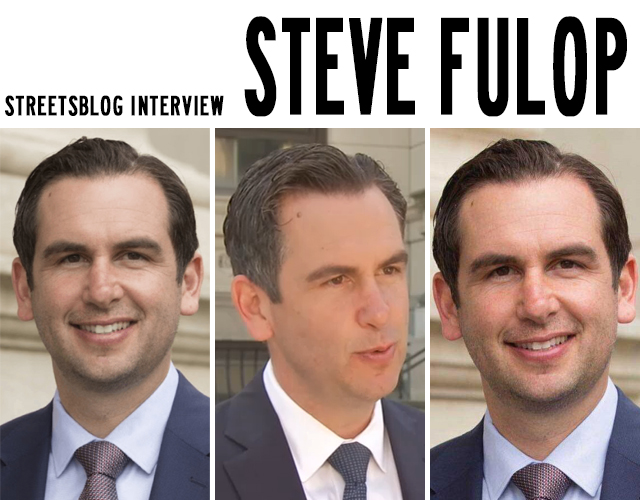
Last month, former Jersey City Mayor Steve Fulop crossed the Hudson River to begin his next chapter as the president and CEO of the Partnership for New York City, the lobbying and advocacy outfit for the Big Apple’s largest corporations.
Fulop, 48, made regular appearances in Streetsblog as mayor for 12 years of the so-called “sixth borough,” where he pushed bike lanes and street pedestrianization and unleashed a housing construction boom that earned plaudits from then-candidate Zohran Mamdani on the campaign trail last year. He staked out courageous positions in favor of congestion pricing and against former Garden State Gov. Phil Murphy’s Turnpike widening debacle.
Fulop succeeds longtime Partnership chief Kathy Wylde, who used her bully pulpit to push Gov. Hochul to enact congestion pricing, among other priorities of the city’s business class.
Streetsblog sat down with Fulop last week to discuss his vision for transportation in his new role. This interview has been edited for length and clarity.
I assume you’ve been meeting with a lot of members of the Partnership’s board. What sorts of transportation issues are coming up in those conversations?
The biggest thing now is Gateway. That’s a mass transit project that impacts the entire region, and we’re trying to leverage some of the relationships that we have in the Partnership with the federal administration, in order to make sure that funding continues. From the mass transit standpoint, it’s vital for the entire region. I’m meeting with activists later in the week to discuss the widening of the Cross Bronx Expressway. I have a lot of experience on this as it relates to the widening of the New Jersey Turnpike in Hudson County.
Which you opposed.
Which I opposed, and I’m meeting with the people that are opposing the Cross-Bronx widening. I think there are a lot of similarities, and I want to listen to why and how, and the impacts to the broader regional economy. So I’m spending a lot of my time right now learning, listening, understanding the issues and, you know, building bridges. I have opinions on which things are important, but ultimately, I work for a board that will set the path.
So you have to then go back to the board and explain to them, these are the concerns about highway widening…
We’re going to be very deliberate and focus on a narrower agenda that impacts more of a cross-section of the 350 CEOs. So I think it’s very important, with the advocacy arm, to be engaged in very specific things. And it’s not necessarily things that I am passionate about. It’s things that cut across the majority of those 350 CEOs and leaders for the betterment of New York. I think that my job at the board meeting is to present the pros and cons of issues, what I’m hearing from people, why it matters to them, and then ultimately, they’re going to have a give and take with me and the board chairs and say, these are things that I think are the priorities for the near-term, mid-term and long-term.
I ask because it’s surprising that the Partnership would be concerned with a highway widening in the Bronx.
I’m not going to say that they care about the highway widening, because I don’t think it’s on any of their radars. But as I’m getting acquainted with the landscape here, I still have my own personal views. It doesn’t mean that the Partnership is going to be leaning in formally as the Partnership on something, but for me, it’s about learning issues and getting a better feel for the landscape.
I’m very involved now, as Kathy Wylde was, in the car insurance reform conversations in Albany. That obviously impacts the affordability conversation that Mayor Mamdani and Gov. Hochul care about greatly. I’ve also talked to some of the advocates on the super-speeder legislation, which I think is very, very good and very, very important. That could also have a positive impact on insurance costs.
That said, I’m still learning the landscape. I would not expect the Cross Bronx Expressway to be an issue the Partnership cares about, but it’s still an issue that I need to learn about and meet the different players around it. I’m spending a lot of time with a lot of different people.
Kathy Wylde was a big advocate for congestion pricing. Are people in the Partnership still talking about that?
I think they think it was the right decision and a big win. It’s a good example of how some of these things take a long time to get done. Kathy was beating that drum for more than a decade, and she played a crucial role in getting it accomplished. So I think the Partnership would say that was a big win. I think Kathy would say that was a big win, and I think New York City is better off. Nine million people may not realize how crucial Kathy was to making that happen, but the truth is that she was — and New York City is better for it.
Congestion pricing, Gateway, the Second Avenue Subway — these are all things that the Trump administration is threatening in one way or another. I know you have a lot of Republicans in your membership. How do you leverage those relationships?
The best way to leverage the Partnership is to recognize that there are many members of the Partnership that have long relationships — decades — with Donald Trump. He’s from New York, and he obviously knows a lot of the people here personally. You saw in San Francisco that personal relationships matter, and they’re the best way to convey a message and ask for help or guidance. I don’t think big, broad statements that virtue signal are that meaningful when we have an asset that others don’t have: we have a personal relationship with the administration, some of its executives, and the ability to have a conversation about the pros and cons of a decision.
I would say the news today out of Gateway was a pretty big statement.
Yes, it’s a pretty big deal, and we’re talking with some of the leadership of the Partnership and its members to reach out to the administration.
To make it clear that there are stakes to these decisions?
Just to convey the importance of that project to the region, and the impact of a delay. I know Sen. Schumer is working really hard on that. And I know New Jersey cares about it greatly. It’s crucial to the national economy, because of the importance of this region for the national economy.
I want to talk about the car insurance thing, because it’s stumped us at Streetsblog.
Why?
The proposed law redefines “serious injury” so that certain things will no longer qualify as a serious injury. Our concern is that this will reduce compensation to the victims of dangerous drivers and not simply punish those dangerous drivers.
Walk me through that again, what you’re saying.
I’m not an insurance expert in any way, but the idea here is that there are a number of levers the governor wants to pull on insurance. One of those levers is altering the definition of a serious injury, which has a mandatory payout of $50,000, so that certain injuries no longer require that mandatory payout. That’s our concern — that this law will limit payouts to victims.
I can tell you the following — and I’m not on the elected side, setting or writing the legislation. I can tell you what we like, what we don’t like, and what we see and what we feel. There is a reality to the affordability conversation, and Mayor Mamdani has hit on that. And any time you engage in any sort of change, there’s always going to be pushback. I learned this, obviously, in Jersey City — nothing meaningful is without costs and benefits, pros and cons.
There is no question that the insurance in New York is an outlier relative to every other state in the country. That is a starting point, and it’s also a fact that New Yorkers pay close to 50 percent more than the majority of other states. These are facts. I understand your concerns, but you have to ask yourself: how do other states handle it in a way that is responsible to victims, but at the same time, controls costs? I think that’s the place you’re trying to get to.
I can’t tell you that the legislation today is going to be the final version. It probably is not. There’s going to be give and take. I think the governor deserves a lot of credit, because a lot of those costs — whether it’s scaffolding law or car insurance — are driven by trial lawyers. They are one of the larger and stronger lobbyist groups in Albany. She deserves credit for engaging in something that is politically tough.
And the thing I would go back to is: New York is an outlier. We are not reinventing the wheel in terms of capping victim payouts, as trial lawyers would like to argue. That is not what is really happening here. We are trying to align with other states and make it more affordable for New Yorkers. Both Michigan and Florida — one has a Republican governor, the other a Democrat — undertook similar insurance reform in the last couple of years and saw costs come down. That should be a model for New York. That is where we are at right now. We could argue around the nuances, but there’s no question that the governor deserves credit. She’s engaging in a tough fight. We have an affordability crisis, and this is a way to confront it.
Isn’t New York potentially also an outlier in the harm situation — the amount of crashes and the amount of pedestrians here?
I don’t think so. There are other densely populated areas of the country. Even if we accept your argument, you still should not see insurance cost 50 percent more than the median, right? It’s still an astronomical number when compared to everywhere else.
Why is this a priority for the Partnership and for its members?
It’s a priority for the Partnership because we are focused on the affordability crisis, and we believe that the governor is being courageous. She deserves credit, and she should be supported if this is her priority — in the same way that we would support the mayor when we overlap and engage on productive issues. We think the conversation around childcare is a productive one. Childcare is a huge cost to New Yorkers, and Mayor Mamdani deserves credit for engaging and bringing it to the forefront.
Don’t housing and wages play as much of a role there?
It’s all of the above. I’m a big advocate for housing construction, and we’re going to be helpful on that. We need to have an honest conversation around property tax reform, because we need to control the cost side of housing construction, too. We will be partners in that conversation. But the Partnership isn’t an elected body. Actual elected individuals set the agenda — and our job is to help, support and push them on that agenda. If Mayor Mamdani wants to talk about childcare, it’s not the Partnership’s role to talk about AI, because that’s not on his radar screen at all. AI is important for job creation, but we’re working within a framework of his priorities right now, and we’re going support him where we can.
Have you heard any complaints from your membership about bike lanes?
No. I love bike lanes. You know that, right?
I do know that. I asked because there’s an ongoing debate in New York City about Fifth Avenue and how it should be redesigned. We have repeatedly seen businesses oppose street redesigns that deprioritize cars.
Yeah, it’s the same way everywhere. We generally defer to the business improvement districts and businesses in the area. It’s not a big issue that the Partnership would talk about in terms of, should we or should we not build bike lanes? People in the Partnership are going to talk more about quality life issues, about public safety issues, about homeless issues — things that are very, very visible, that touch every corner of the city.
So you don’t expect somebody to come and ask, Hey, Steve, I really need you to help me out with this bike lane coming through my neighborhood.
No, no. That was my life in Jersey City.
Have you ever been in a situation where a business owner says, you know, all my customers get here by car and you’re taking away a parking spot. What do you tell them?
In downtown Jersey City, we closed blocks and blocks of Newark Avenue, we restricted vehicles and we installed a bike lane on Christopher Columbus next to it. Businesses pushed back. They pushed back for the same reason — I’m an optometrist, and I need somebody to park near to walk to the eye doctor. This person has a pharmacy, and that person has customers that buy this or buy that. We heard it. It was a process.
We ended up getting it through, and four or five years later, those same businesses would tell you that they have done better financially than they ever did before, just because of what we did. The redesign made it more inviting for people.
I can’t tell you whether the Partnership would ever engage in constructing a specific bike lane policy, but I’m an ally, and I’m passionate about cycling and bike infrastructure.
We haven’t really had wide-scale pedestrianization here, such as entire blocks or areas cut off from vehicular traffic. I think the city has been reluctant to do that because they don’t want to ruffle the wrong feathers.
I think people should feel good about Mayor Mamdani in this space. He’s young and policy-centric, and he’s going to approach and think about these things in a different way. I was very, very similar to the mayor of Jersey City. I was younger. I had ideas about technology, ideas about infrastructure, that an older person across the river did not. I think Jersey City benefited from that. Once Mayor Mamdani finds his footing, he’ll be more proactive on some of these things, and the city will benefit.
Do you see the Partnership having a role in advocating for transit expansion?
That will be determined by the board I work for, the governor’s agenda and the mayor’s agenda. But I do think that expansion is one of the most important parts of economic development. If you’re not focused on transit expansion, and how to move people to and from work, you’re going to fail. I think that that is a core mission. It’s why we spend time on Gateway, because we are thinking about the transit infrastructure in this area
Have you met with Janno Lieber yet? What did you guys talk about?
Yes. We talked a little bit about the overall policy history of New York and New Jersey, and the PATH. We talked about insurance reform coming out of Albany and the money that could be saved there.
For the MTA? How much? Do you have an estimate?
It’s real money. You gotta ask him, but it’s real money. Big.
Tens, hundreds of millions?
More. Big.
Did he have any requests for you or priorities that he wanted to communicate to you?
I’ll keep that in confidence for now.
Fair enough. Were there any points of mutual interest?
Obviously, I care a lot about transportation infrastructure. It’s one of the reasons why I reached out to him. He was obviously familiar with where I was at in terms of congestion pricing, and my history with trains and public transportation.
I felt that New Jersey should have participated in a regional solution to congestion pricing. I thought, and I still think, that if you are going to really confront the transportation needs of New York, New Jersey and Connecticut, you need to cooperate instead of operating all of these legacy train systems that emerged from historical rivalries from the 1920s and 1930s. I think it’s ridiculous. I thought it was an opportunity for New Jersey to cooperate with New York.
You probably missed out on benefits as a result.
We missed out tremendously.
Have you been following the Penn Station news at all?
I was in Penn station yesterday with somebody who gave a tour of the nuances of where everything is situated and the history of it. I’ve been to Penn Station many times as a passenger, and never thought of it in that way. But I was there yesterday.
Who gave the tour, can I ask?
I prefer to keep that in confidence.
How are you approaching the Trump administration’s work there?
I’m listening. I’m meeting with our board in the next couple of weeks, and my job is to lay everything out and say, here’s what I’m hearing, and here’s what I hear from the public, and here’s what I hear from elected officials, and here’s what I think that we should be focused on. So I’m spending time just meeting a lot of different people and learning all this stuff.
When you met with Mayor Mamdani, did transportation come up in that conversation?
No. Those conversations were about housing and childcare.
Housing is sort of about transportation, right?
Well, it was more focused on: how do you build more housing? How do you incentivize the private sector to facilitate growth at a very much higher rate?
Are your members surprised that the socialist mayor is so interested in that?
Having a socialist mayor is uncharted territory. What does it mean, right? Is it just a title, and then there are some pragmatic middle-of-the-road solutions? Will the city socialize different aspects of government? Nobody knows, right? The fact that you could have somebody who defines himself as a socialist mayor was surprising to people. But he’s doing his best to build bridges. That’s a good sign.

Streetsblog has migrated to a new comment system. New commenters can register directly in the comments section of any article. Returning commenters: your previous comments and display name have been preserved, but you'll need to reclaim your account by clicking "Forgot your password?" on the sign-in form, entering your email, and following the verification link to set a new password — this is required because passwords could not be carried over during the migration. For questions, contact tips@streetsblog.org.