DOT Will Replace East Village ‘Mixing Zones’ With Semi-Protected Intersections
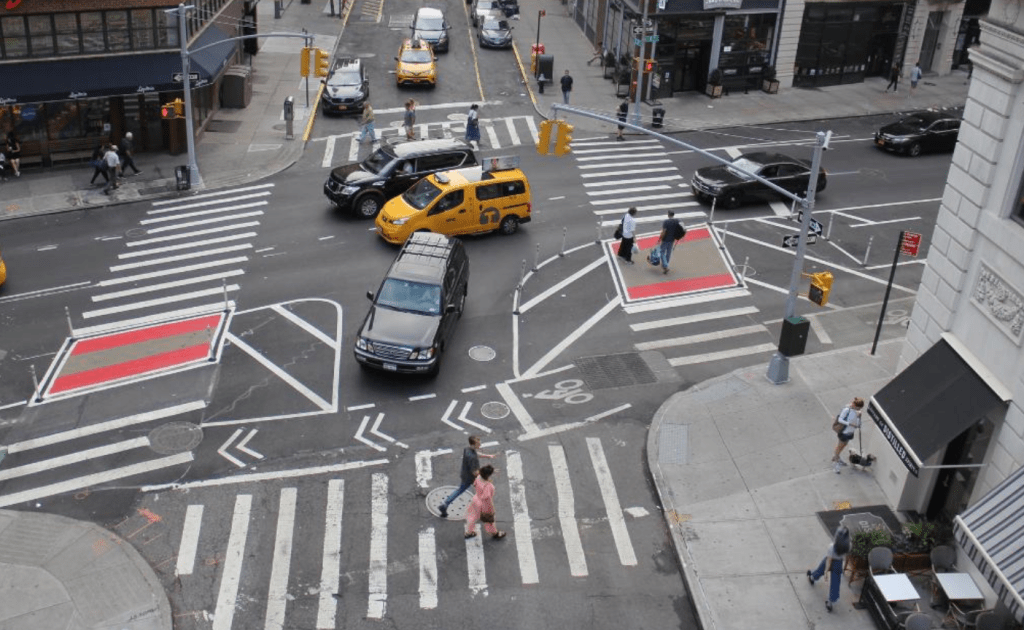
The First and Second Avenue protected bike lanes are about to get a whole lot safer in the East Village.
Now that both Manhattan roadways have been repaved, DOT says install new intersection designs that enhance safety for people on bikes and on foot — culminating two years of pressure from cycling advocates after the death of Kelly Hurley.
They’re two of the city’s safest protected bike lanes, but two years ago, a box truck driver turned into and killed Hurley, 31, at the intersection of First Avenue and Ninth Street. In the aftermath of her death, advocates implored the agency to rethink its use of “mixing zones” — which force cyclists and drivers to negotiate the same space at the same time.
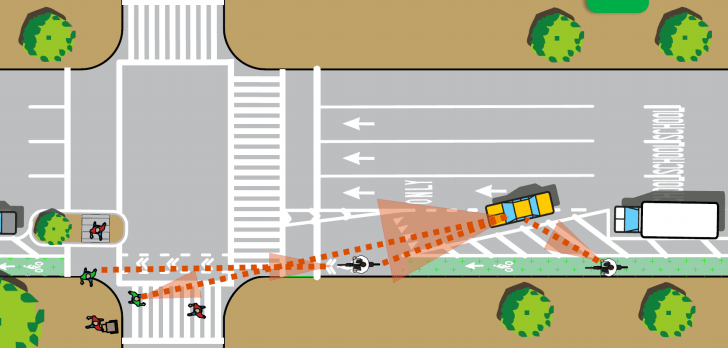
After Hurley’s death, Upper West Side architect Reed Rubey came up with an alternative design, which was subsequently endorsed by Manhattan Community Board 4. Rubey’s efforts partly inspired DOT’s chosen solution: the offset intersection, which it piloted at select locations in 2017 and 2018. In September, DOT’s “Cycling at the Crossroads” report showed that cyclists felt significantly safer at intersections with offset crossings [PDF].
Yet while most DOT surveyed feel safer cycling at offset crossings, the agency found that the design tricks some cyclists into thinking they must yield to the driver, in part because drivers were turning at high speeds. The report recommended modifications to slow driver speeds, and DOT continues to use mixing zones on lower traffic streets.
After a slow initial rollout, DOT is going big on offset crossings. In addition to First and Second avenues, it plans to include them in Brooklyn’s Fourth Avenue redesign, which is being implemented.
Bike New York Communications Director Jon Orcutt, a former city DOT official, welcomed the revamp of the Manhattan avenues.
“Since DOT published its report on bike lane intersections last fall, it’s been an open question whether we would see the offset design primarily along new bike lanes or also mixing zone retrofits,” he said. “We applaud this important step.”

Read More:
Streetsblog has migrated to a new comment system. New commenters can register directly in the comments section of any article. Returning commenters: your previous comments and display name have been preserved, but you'll need to reclaim your account by clicking "Forgot your password?" on the sign-in form, entering your email, and following the verification link to set a new password — this is required because passwords could not be carried over during the migration. For questions, contact tips@streetsblog.org.