Most Council Members Want DOT’s Routine Paving Projects to Incorporate Safer Street Designs

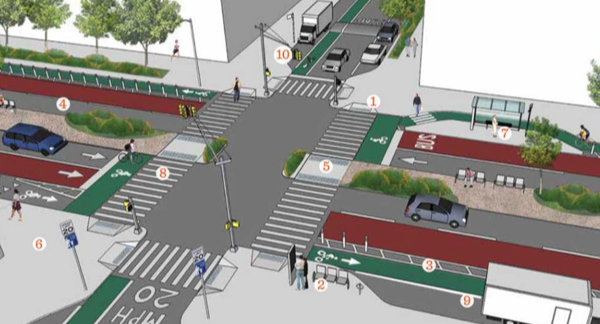
A majority of the City Council has signed on to support the proposition that whenever DOT repaves a street, it should add design and engineering elements that make walking and biking safer.
A total of 27 council members have endorsed Transportation Alternatives’ “Vision Zero Street Design Standard,” which calls on DOT to maximize the use of 10 elements from the agency’s own Street Design Manual. Though not every street is appropriate for all 10 — which include bus lanes, protected bike lanes, and wider sidewalks — TransAlt recommends that DOT incorporate as many as possible whenever a street is repaved.
Since DOT resurfaces about 1,000 lane-miles of streets every year, but most paving projects currently just replicate the existing street design, the effect would be to greatly accelerate the implementation of safety improvements. The support of a City Council majority also gives the agency more political leeway to make changes during repaving projects without getting bogged down in the community board process.
From a TransAlt press release:
Street redesign projects are often subject to a lengthy political processes and can take years to complete. But the Vision Zero Street Design Standard calls for a quicker, less expensive protocol for fixing dangerous streets by integrating safety improvements as part of regularly scheduled resurfacing. These improvements could be made using low-cost materials like paint and plastic bollards, or through retiming signals and implementing leading pedestrian intervals.
Since council members wield a lot of influence over street projects in their respective districts, majority support for the design principles laid out by TransAlt is a big deal.
“If we’re going to reach Vision Zero by 2024, then we need to take advantage of these regularly scheduled projects,” said TransAlt Executive Director Paul White in a statement, “adding elements that slow drivers and establish safe rights of way for people on bikes and on foot.”
Transportation chair Ydanis Rodriguez plans to back up the council’s endorsement with legislation, according to TransAlt. We have a message in with Rodriguez for details.

Read More:
Streetsblog has migrated to a new comment system. New commenters can register directly in the comments section of any article. Returning commenters: your previous comments and display name have been preserved, but you'll need to reclaim your account by clicking "Forgot your password?" on the sign-in form, entering your email, and following the verification link to set a new password — this is required because passwords could not be carried over during the migration. For questions, contact tips@streetsblog.org.