Albuquerque’s Ground-Breaking BRT Project Makes Its Maiden Voyage on Route 66

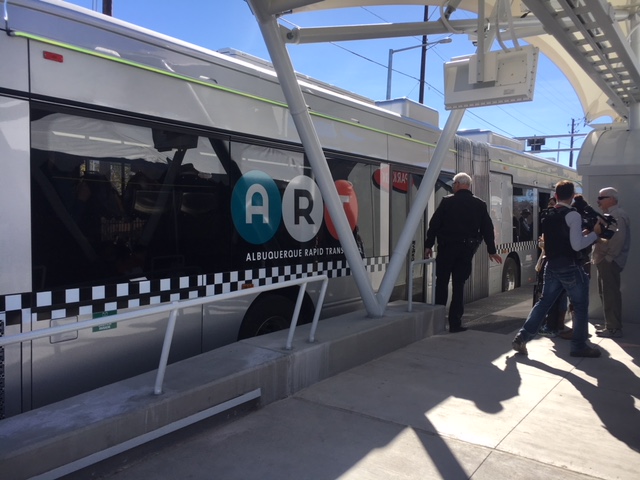
It took some serious political fortitude for Albuquerque to reach the milestone it crossed this weekend, when the city launched service on its nine-mile “ART” bus rapid transit line.
To free ART buses from traffic congestion, the city carved out a center-running transitway on Central Avenue, Albuquerque’s main drag. Like any project that upends the status quo, ART stirred up fierce opposition, led in this case by some local business owners and Koch-funded astroturf groups.
Through it all, Albuquerque Mayor Richard Berry, a Republican, didn’t waver. ART debuted with a transitway design that the Institute for Transportation and Development Policy rates higher than any other BRT project in the nation. (ITDP will rate service on ART later, after it’s been running for six months.)
With dedicated center-running transit lanes, ART buses aren’t slowed down by drivers pulling up to the curb or turning right. Platforms are level with the floor of the bus, and passengers pay before boarding and can use any door, cutting down on the time buses spend at stops. Special traffic signals will hold green lights for buses and limit the time they spend stopped at reds.
These improvements will speed transit on the city’s busiest bus corridor. Central Avenue carries 42 percent of Albuquerque’s transit trips — about 15,000 per day. The busway will improve trips for low-income workers while providing a spine of high-quality transit to anchor new development.
ITDP’s Michael Kodransky pointed to the importance of zoning changes that Albuquerque implemented in tandem with ART. For development near ART, the city nixed minimum parking requirements and allowed mixed-use buildings.
“They’re already seeing new investment coming up,” said Kodransky. “Over $300 million of mixed-use development is already moving into the corridor.”
Some aspects of the project are still incomplete. A few ticket vending machines have yet to be installed, and the city will be working on landscaping through the beginning of 2018.
Not all of the new ART buses are in service yet either, though the city says they will be by the end of the month. And while the design of ART is the best in the country, getting the operations right is a whole other challenge, says Kodransky. The city has increased frequencies to run buses every 7.5 minutes during peak hours and at least every 15 minutes between 6 a.m. and 10 p.m. Still, waits of up to 15 minutes are on the long side for a major transit route.
It remains to be seen whether ART will make sprawling Albuquerque a more walkable, transit-accessible city. But dedicating a bus lane on historic Route 66 sends a strong message that change is coming. And despite initial resistance, Kodransky says, the business community has since embraced the project.
“They really sold it as something that the whole city could be proud of,” he said.

Read More:
Streetsblog has migrated to a new comment system. New commenters can register directly in the comments section of any article. Returning commenters: your previous comments and display name have been preserved, but you'll need to reclaim your account by clicking "Forgot your password?" on the sign-in form, entering your email, and following the verification link to set a new password — this is required because passwords could not be carried over during the migration. For questions, contact tips@streetsblog.org.