NYC DOT Plans Protected Bike Lane for 24 Blocks of Seventh Avenue
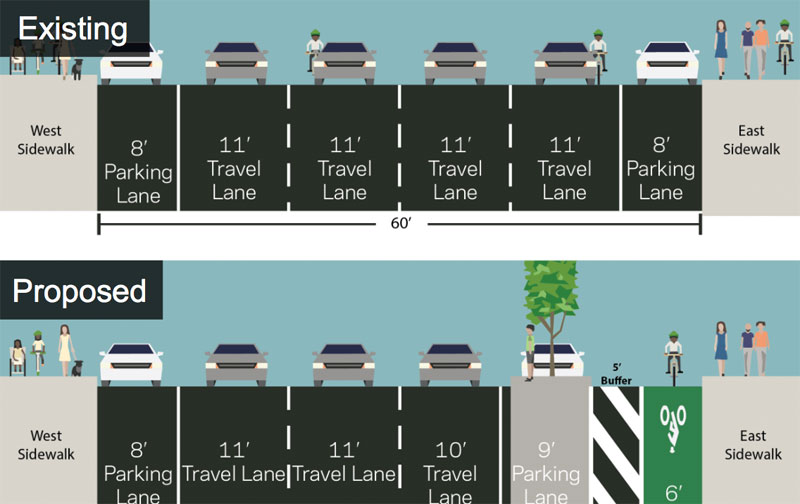
DOT aims to install a protected bike lane on Seventh Avenue from 30th Street to Clarkson Street by the end of the year. Agency staff presented a portion of the project at last night’s Manhattan Community Board 4 transportation committee meeting.
Wide, one-way Seventh Avenue is prone to speeding and has little congestion most of the day. But in Chelsea and the West Village, it’s a rarity: an avenue without a protected bike lane. Nevertheless, many people are already biking there. In a 14-hour period, DOT counted 1,700 people biking at 30th Street, 2,350 at 20th Street, and 1,300 at Charles Street.
“Despite the fact that there are nearby alternative routes for people to be biking on, that already have protected lanes, there are still so many people [biking] on Seventh Avenue,” said DOT project manager Nick Carey.
Between 30th Street and 14th Street, DOT’s plan calls for a parking-protected bike lane on the east curb — the left side of southbound Seventh Avenue — and reducing the number of motor vehicle traffic lanes to three. Crossing distances for pedestrians will be shortened and the narrower roadway should reduce speeding [PDF].
The more complicated segment will be Seventh Avenue South, in the West Village, where diagonal streets make for long crossing distances and extra turning phases. That part of the project will be presented to CB 2 in May.
Much of the discussion last night focused on the safety of DOT’s intersection designs. Only two intersections on Seventh Avenue in CB 4 are in line for split-phase signals that give cyclists green lights separately from turning motorists. The rest will rely on “mixing zones,” where cyclists and turning motorists negotiate the intersection at the same time. Split-phase signals have a safer track record than mixing zones.
Carey said DOT is planning to study and reevaluate intersection design on protected bike lanes. There’s no timeframe for the study, but he said it should result in new, safer intersection designs based on international best practices.
The CB 4 committee endorsed DOT’s plan unanimously, with requests that the signals be timed for 25 mph traffic speeds, that the motor vehicle lanes be as narrow as possible, and that intersection designs be reevaluated, particularly at 17th Street and 19th Street. On Monday, DOT will present the segment between 30th Street and 26th Street to CB 5.
CB 5’s transportation committee meets next Monday, April 24, at 6 p.m. CB 2 hasn’t posted information about its May calendar, so keep your eyes on the Streetsblog calendar for updates.

Read More:
Streetsblog has migrated to a new comment system. New commenters can register directly in the comments section of any article. Returning commenters: your previous comments and display name have been preserved, but you'll need to reclaim your account by clicking "Forgot your password?" on the sign-in form, entering your email, and following the verification link to set a new password — this is required because passwords could not be carried over during the migration. For questions, contact tips@streetsblog.org.