Kansas City Will Take a Serious Look at Removing Downtown Highway

Rochester just wrapped up the conversion of part of its Inner Loop highway into a surface street, another highway removal is underway in New Haven, and freeway teardowns are in play in many other American cities.
Now you can add Kansas City to the list of places getting serious about removing a grade-separated highway to save money, improve walkability, and open up downtown land for development.

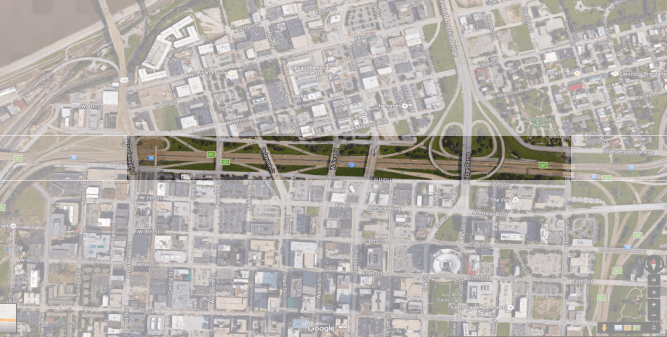
Eric Bunch at BikeWalkKC says the regional planning agency for the two Kansas Cities (Missouri and Kansas) is studying the removal of a section of I-70:
The study will propose several potential alternatives for the future of the Buck O’Neil (formerly the Broadway Bridge), the north leg of the Downtown KCMO freeway loop, and the elevated I-70 lanes into Downtown KCK.
Consultants for the project will likely evaluate the feasibility of tearing down the I-70 lanes between Columbus Park (KCMO) and Downtown KCK, setting Kansas City up to join the growing national trend of urban freeway removal.
Freeways once brought connectivity and convenient shipment of goods into urban centers and they made travel by car easier. But they also brought poor air quality noise pollution to densely populated areas. But even more, they proved to be extremely destructive to the communities they pass through, scarring historic neighborhoods and cutting off connectivity for residents.
If the complete removal of this section of I-70 proves to be feasible, the opportunities for catalytic, legacy projects abound.
- Improved Walkability: The street grid between Downtown Columbus Park and River Market could be restored.
- Development Potential: The trench that carries the north loop lanes contains hundreds of acres of prime downtown real estate that could be redeveloped into pedestrian/bike friendly uses.
- Catalytic Trail Project: Imagine reusing the elevated lanes between the River Market and Downtown KCK as an elevated bicycle and pedestrian trail. Look at the impact of The Big Four Bridge in Louisville, KY.
More recommended reading: Bike Portland reports that local officials are using emergency measures to curb speeding on a dangerous road. And Daniel Kay Hertz points out that, contrary to popular perception, a lot of kids live in Chicago.