How Much Does DOT Use Daylighting to Reduce Dangerous Turns?


Transportation Commissioner Polly Trottenberg told the City Council there’s only so much DOT can do to prevent drivers from hitting people while turning, but there’s a relatively simple safety measure the agency could put to widespread use: keeping parked cars away from intersections.
Last week, Kate Hinds at WNYC reported on the problem of motorists fatally striking people while turning left. According to crash data compiled by Streetsblog, drivers making right and left turns killed 30 pedestrians and cyclists in NYC in 2014.
WNYC noted several factors that contribute to such crashes, including traffic signals that direct pedestrians and motorists into crosswalks at the same time, drivers who are occupied with several tasks at once (the feds call it “driver workload”), and “blind spots” caused by wide A pillars.
In March, Hinds reported, Trottenberg told the council “there are limits to what can be done” to prevent turning crashes.
“Left turns are a big source of crashes,” Trottenberg said. “But there’s another way to look at it: speeding and failure to yield, which are also pieces of the puzzle, are also sources. There’s no question, in cases where we can minimize left turns, or give vehicles their own turning phase, we want to try to do that.”
She added, however, “We won’t be able to do it everywhere in the city. You can’t create a special turning lane and a special signal in every intersection for left turns.”
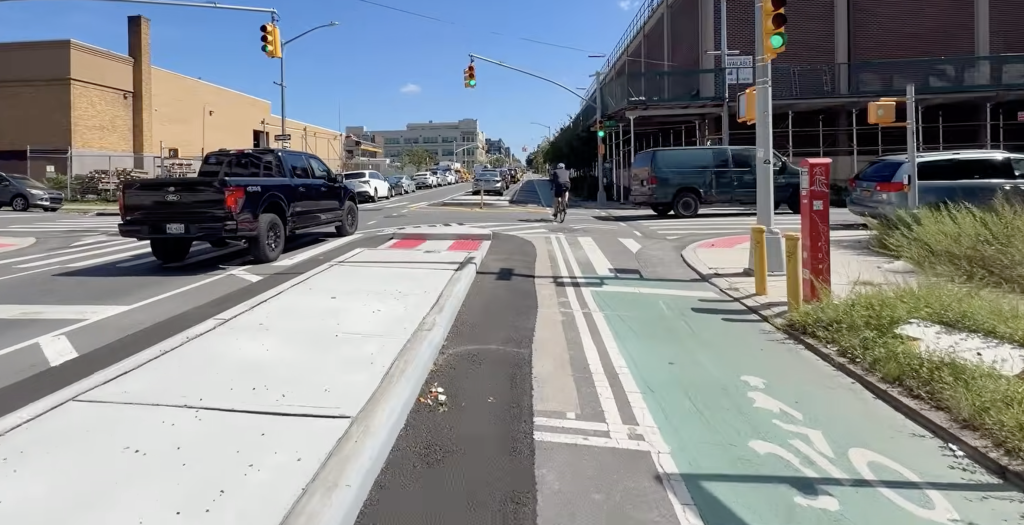
One factor that Trottenberg didn’t mention is that many fatal turns occur at intersections where visibility is hindered by cars parked to the edge of crosswalks, a practice that is permitted in New York City but against the law in other places. As we reported earlier this year, NACTO recommends 20 to 25 feet of clearance around crosswalks.
In 2011, acting on recommendations in its Pedestrian Safety Study and Action Plan, DOT daylighted the corners on several blocks of Lexington Avenue in Midtown. The project seemed like it could set a precedent for quickly improving other dangerous intersections around the city. How many intersections is DOT daylighting now?
We asked DOT to what extent the agency is daylighting intersections to improve visibility at corners, and if DOT follows NACTO daylighting guidelines. DOT said its practices are consistent with NACTO, and that the agency “uses daylighting as appropriate.” DOT said it reviews crash reports and crash data to “develop strategies and interventions,” and is conducting a study, mandated by the City Council, which will guide the agency’s approach to addressing turning conflicts.
DOT didn’t offer any specifics about where and to what extent it has employed daylighting.

Read More:
Streetsblog has migrated to a new comment system. New commenters can register directly in the comments section of any article. Returning commenters: your previous comments and display name have been preserved, but you'll need to reclaim your account by clicking "Forgot your password?" on the sign-in form, entering your email, and following the verification link to set a new password — this is required because passwords could not be carried over during the migration. For questions, contact tips@streetsblog.org.