Advocates: New Parking Requirements Make Housing More Expensive

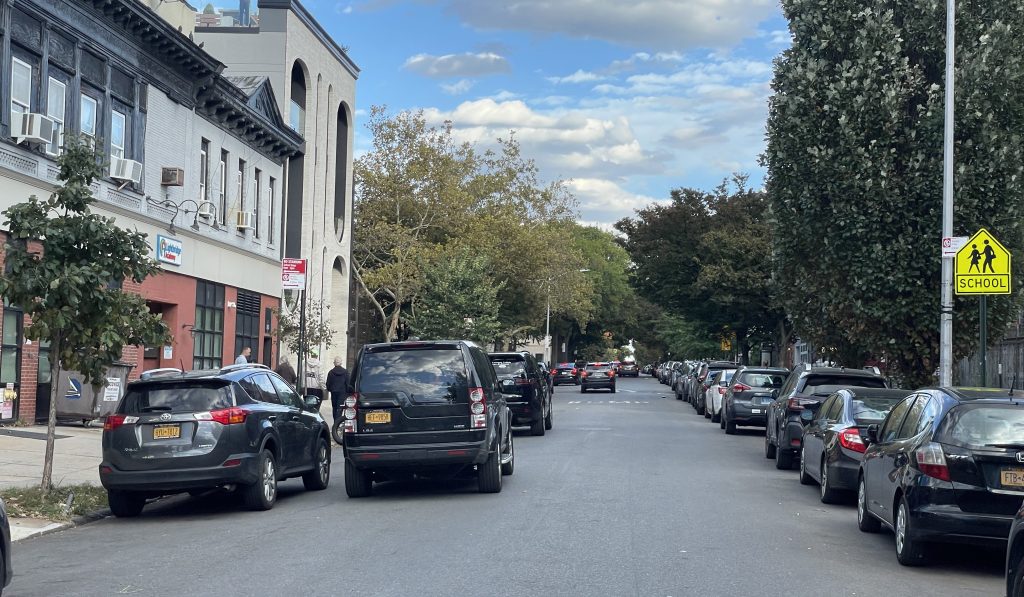
Reforming New York City parking policy is a critical component of reducing automobile use and building better public spaces. It’s becoming increasingly clear that rethinking how we store cars can help address New York City’s housing crisis as well. Requiring parking not only creates traffic, it also prevents housing from being built and drives up prices.
 A front yard parking pad, which the residential streetscape amendment is intended to prevent. Photo: DCP
A zoning change passed by the City Council this month — the Residential Streetscape Preservation Text Amendment (RSPTA) — could be a step in the wrong direction for both parking reform and affordable housing. By tinkering with off-street parking regulations, housing advocates say, the Department of City Planning has obstructed the construction of safer and more affordable housing stock.
The RSPTA was intended to cut down on the curb cuts and front-yard parking pads proliferating in the city. It’s a laudable goal. As we reported last November, curb cuts put pedestrians at risk from cars crossing the sidewalk.
But that’s not all the amendment does. Though PlaNYC calls for creating homes for a million more New Yorkers that are more affordable and sustainable than the buildings of today, the amendment erects new barriers to the construction of housing in a market where the scarcity of residences drives rents and prices higher.
 When you have to put parking in a side yard, you can’t build new rowhouses or add to existing attached housing. Image: DCP
Under the amendment, adding a new unit to residential buildings in many places across the city now requires adding an off-street parking space as well, which will ultimately prevent many units from ever being built, housing advocates say.
In some mid-density neighborhoods, like parts of Dyker Heights in Brooklyn and Forest Hills in Queens, the RSPTA forbids putting parking in the front or rear yard of a building, but off-street parking is still allowed in driveways along the side of a building, or in a household garage. Many of these zones, though, are typified by one- or two-story attached housing. “A lot of those properties are not going to be able, physically, to add a side-yard parking spot,” said Jerilyn Perine, the executive director of the Citizens Housing and Planning Council and a former housing commissioner under Giuliani and Bloomberg. “You can’t do it if you’re attached on both sides.”
The RSPTA therefore makes it impossible to create new units, through construction or bringing previously informal units up to code, in those areas. “That’s a very strong statement to come in an amendment that’s ostensibly about parking and front yard plantings,” said Perine.
Elena Conte of the Pratt Center for Community Development agreed with Perine’s analysis. “By requiring a new parking space,” she said, the amendment “erects a significant barrier to the creation of new units in these zones.”
In areas where new development is underway, the result is similar, though less drastic. “By restricting parking to a side-yard ribbon only,” said Perine, “in a new development environment you essentially can’t do a row of little two-story buildings and meet the parking requirement.” The result, she said, will be less-dense and less-energy efficient detached houses.
Conte agreed that the RSPTA will lead to more detached units being built than if the amendment had never passed. “This runs counter to the widely accepted principles of smart growth,” she said.
In addition, the RSPTA’s parking requirements will force builders to spend more money on housing construction. The cost of a parking space in a low-density neighborhood isn’t make-or-break for most developments, said Perine, but it’s no coincidence that “obligations keep getting added to new housing development and then people are dismayed when the cost of housing continues to increase.”
The RSPTA’s effect on housing prices will add to the more significant burden imposed by parking minimums for larger residential developments, said Perine. “On the multi-family side,” she said,
“there’s no question there’s a clear cost hit there.”
The Department of City Planning contests the claim that the changes will affect the housing market. DCP sees the changes as simply clarifying existing regulations, according to a spokesperson, who emphasized that the amendment will “enhance the walkability of neighborhoods by regulating where curb cuts may be placed.”
Despite her belief that the city’s parking regulations will impede efforts to build more housing and drive up housing costs in many parts of the city, Perine isn’t calling for scrapping the city’s off-street parking minimums. “We just wish there would be a bigger picture discussion of land use and parking and housing development,” she said, “instead of these piecemeal text changes.” The Department of City Planning’s ongoing citywide analysis of parking demand provides a perfect opportunity to take a step back and assess the whole situation, she added.
Until that’s complete, Perine argued, the department should stop sneaking new parking requirements into unrelated amendments, like one theoretically targeted only at preventing curb-cuts. “What’s that got to do with streetscapes?” she asked.

Read More:
Streetsblog has migrated to a new comment system. New commenters can register directly in the comments section of any article. Returning commenters: your previous comments and display name have been preserved, but you'll need to reclaim your account by clicking "Forgot your password?" on the sign-in form, entering your email, and following the verification link to set a new password — this is required because passwords could not be carried over during the migration. For questions, contact tips@streetsblog.org.