Complete Streets Planning Becomes Law in Hawaii

In more and more communities around the country, the benefits of complete streets — designed for the benefit and safety of all users, not just automobiles — are becoming clear. The latest advance comes in Hawaii, where the governor has signed legislation that makes building complete streets a state policy. Today on the Streetsblog Network, Transportation for America has the news, and a reminder that change at the national level is still possible:
This street could soon be a lot safer. Photo by David M. Hepburn via Flickr.
Hawai’i’s policy comes right on the heels of an executive order from Delaware Governor Markell, directing the Delaware state transportation department to create a policy to “promote safe access for all users, including pedestrians, bicyclists, motorists and bus riders of all ages to be able to safely move along and across the streets of Delaware.”
Hawai’i’s bill marks the 92nd policy at any level passed in the U.S. But even as cities like Rochester, MN, and states like Hawaii are passing their own policies, there is still a chance to get complete streets enacted at the federal level — requiring that any roads built with federal dollars consider the needs of all users while in the planning process.
Complete streets bills are still circulating in Congress, and T4 America and The National Complete Streets Coalition are looking for legislators to sign on and co-sponsor these important bills.
It’s not too late. Write your member of Congress today and tell them to support or co-sponsor this important legislation.
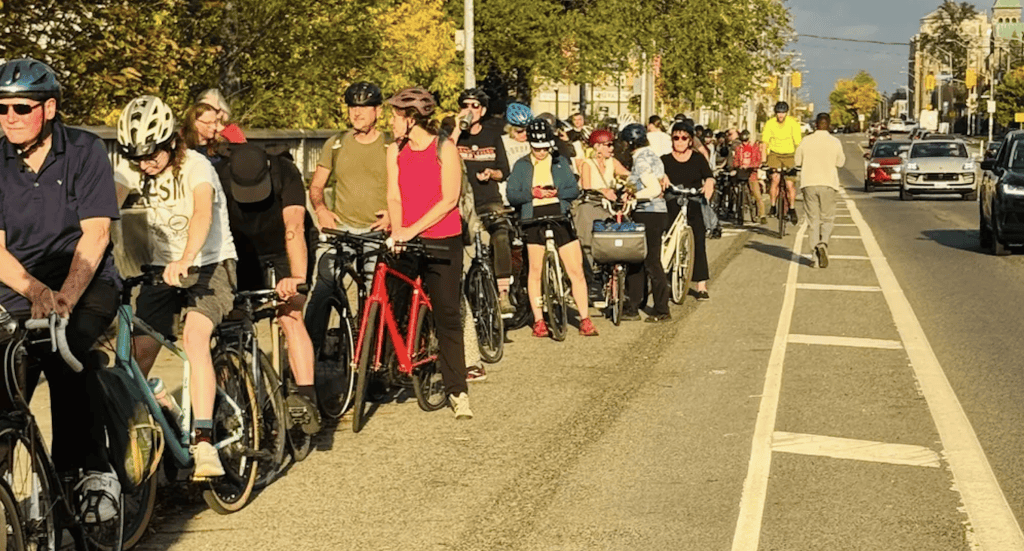
Complete streets legislation could have a profound effect on conditions for bikers, and that could be key for bike safety. Today the Streetsblog Network is also featuring a post from WorldChanging about how a new study from the UK’s Cyclists Touring Club (CTC) confirms that bike riders find safety in numbers:
The trend is clear, with areas popular for cyclists tending to be
safer on average, with the differences sometimes significant. …The phenomenon …can be seen throughout
Europe. Other figures compiled by the organisation show that in
Denmark, top of the continental league for cycling, the average person
rides over 10 times further than his British peer every year but runs
only 20% of the risk of being killed.The reasons for this
inverse correlation are many, according to [Chris Peck, the CTC’s policy coordinator], and include the
likelihood of better cycling infrastructure in areas where more people
ride, the fact that if car drivers also occasionally cycle they are
likely to be more careful with bikes, and the statistical quirk that a
higher proportion of riders in low-cycling areas tend to be young men
with a higher than average threshold for risk.“It’s a virtuous
circle: people feel safe, they know a lot of people who also cycle and
say, ‘it’s OK, get out there. It’s even a pleasant way to get around,'”
said Peck. “They’re much more likely to get on a bike if they know,
say, a friend or neighbour who cycles.”
And a final feel-good tidbit for your weekend: In Montréal, according to member blog On Two Wheels, an anonymous donor is continuing a tradition of giving bicycles to some very deserving kids. It’s his birthday present to himself — and he’s turning 84 this year.

Read More:
Streetsblog has migrated to a new comment system. New commenters can register directly in the comments section of any article. Returning commenters: your previous comments and display name have been preserved, but you'll need to reclaim your account by clicking "Forgot your password?" on the sign-in form, entering your email, and following the verification link to set a new password — this is required because passwords could not be carried over during the migration. For questions, contact tips@streetsblog.org.