GET OUT: E-Bike Battery Fires are a Crisis We Can No Longer Ignore
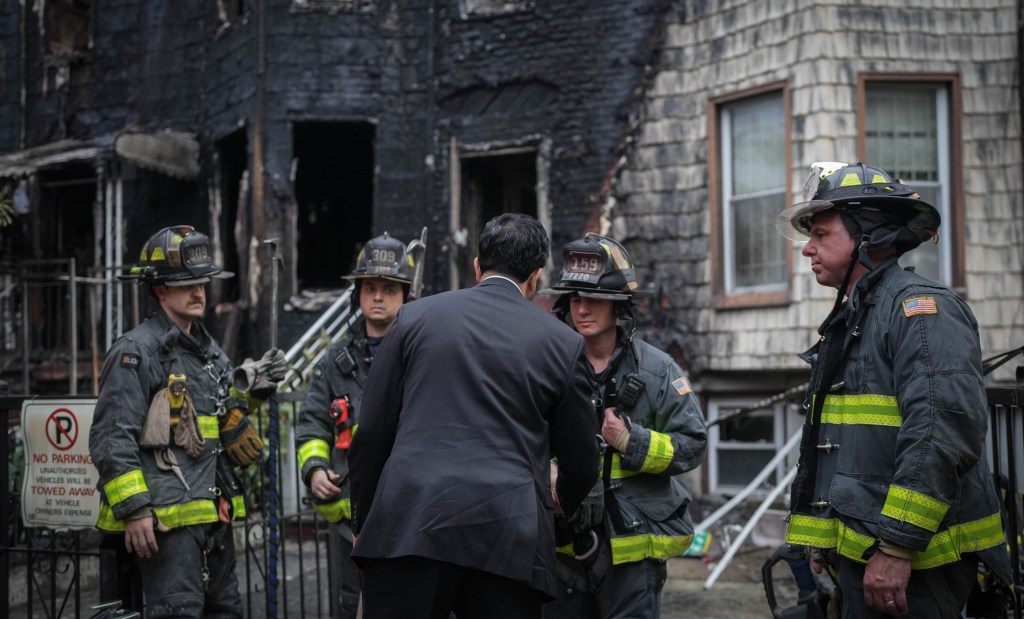
Back-to-back mass-death fires in Brooklyn and the Bronx have rocked the city these past two weeks, taking ten lives and ripping apart countless more, as reported in the Times, News, Post, Hell Gate, City Reporter, Gothamist, and of course Streetsblog. Substandard e-bike batteries likely triggered both conflagrations, an all-too-common occurrence that should shock street-safety and cycling champions into action.
Over the past decade, e-bike battery fires in New York City have killed dozens of residents and injured many more. They have rendered hundreds of apartments uninhabitable. Yet micromobility advocates have had little to say, treating this as an anomaly and not a core problem.
City government is complicit, too. On Oct. 28, three teens and their mother died from burns after their father’s e-bike erupted in flames in their Mott Haven apartment. The next day, Mayor Mamdani and Fire Commissioner Lillian Bonsignore offered up pablum: don’t leave e-bikes in doorways, don’t charge them overnight and try to store them outdoors. We might just as well dispense with highway lane markers and beseech drivers to take it easy.
Officials took a similar tack after the Nov. 5 Brooklyn disaster, when another fast-moving fire, also apparently sparked by an e-bike battery, killed six residents of a two-story frame house in Sunset Park. The blaze marked the greatest loss of life from a single fire in New York City since the 2022 Twin Parks fire in the Bronx. Mamdani vowed to find a solution but omitted any specifics. Bonsignore was out of town and did not comment.
Even before the Mott Haven and Sunset Park blazes, e-bike-related fires across the five boroughs rose 41 percent from 2025. Batteries caused at least 406 fires this year, versus 241 over the same period in 2025 — a 68-percent increase.
“Every single New York City resident should be furious,” said Brooklyn-based street-safety advocate and battery-swap entrepreneur Baruch Herzfeld. He’s right. We cyclists assert the moral high ground as we battle car and truck drivers and their elected enablers. We solemnly memorialize New Yorkers whom motorists kill on our contested streets. Yet this adjacent conflagration finds us largely silent.
This problem has persisted for so long that multiple mayors have “cracked down” on it, at multiple times in multiple ways, with little evident change. Between August and mid-September, the city’s Department of Consumer and Worker Protection inspected more than 200 bicycle and micromobility shops and issued 136 violations that led to 77 summonses. But it was insufficient: the agency’s sweep primarily targeted vehicles equipped to exceed the city’s speed limit of 20 mph for scooters and 20 mph for e-bikes — not hazardous batteries.
This infernal calamity traces to the uncertified lithium-ion batteries that power thousands of e-mobility devices on the city’s streets. Extravagantly distant food delivery — enabled by the lack of a mileage surcharge — compounds the disaster by requiring longer and more frequent charging cycles.
What Sets UL-Certified E-bike Batteries Apart
We think of batteries as mundane pieces of technology. Nobody fears the small metal disc that powers their wristwatch or the slightly larger cylinder in their television remote. E-bike batteries, by comparison, are complex devices that must operate over variegated conditions for long periods of time. That led Underwriters Laboratory to publish their first light-vehicle electric-battery safety standard, known as UL 2271, in 2013.
William Henry Merrill, an M.I.T.-educated electrical engineer and electrical inspector for the Boston Board of Fire Underwriters, founded UL in 1894. Now a multinational conglomerate with $3 billion in annual revenue, UL maintains safety standards for e-bike batteries. It is one of a few firms authorized by the U.S. Occupational Safety and Health Administration to certify their safety.
To win UL certification — those upper-case initials in a circle you’ve probably seen a thousand times but never really noticed — batteries must demonstrate that they can interrupt overheating, cut off power to battery elements in the event of over-charging or over-discharging, and prevent short circuits from triggering high-energy fires or explosions. In contrast, many uncertified batteries lack automatic shutoff controls or employ generic chargers that can overpower battery cells. They’re also less protected from damage from road jostling, moisture ingress and everyday wear-and-tear.
Many deliveristas ride cheaper e-bikes and scooters manufactured by obscure Chinese brands with cheap and swappable batteries. New York City has never recorded a fire caused by a UL-certified e-bike or other micromobility device. From all appearances, replacing the off-brand batteries with UL-certified batteries is both necessary and sufficient for fire-safe micromobility.
How to rid the city of substandard e-bike batteries
I propose a two-step solution:
- Enact a municipal ordinance authorizing the immediate seizure and confiscation of non-UL-certified lithium-ion batteries from residential, commercial and institutional buildings in the five boroughs.
- Impose a steep surcharge on food deliveries administered by food-delivery app companies such as Doordash and Uber Eats. The levies will pay for a new FDNY-DCWP task force to hunt down the non-compliant batteries.
How big a surcharge? I approached this question by estimating the annual societal cost of e-bike battery fires and dividing that figure by the number of annual deliveries via e-bike. The result is a fee of $15 per delivery. (Yes, there would be parallel surcharges for deliveries by car or truck; and yes, the charge should graduate by distance.)
To be sure, my $15 estimate is much less finely drawn than is my wont, owing to inexact figures on the frequency and societal costs of e-bike battery fire deaths, injuries and dwellings destroyed. It’s also a broad-brush figure, since not every e-bike is used for food-delivery. Case in point: the burning e-bike in Mott Haven was apparently gifted to the father — who remains in a medically induced coma — and probably wasn’t used for business purposes.
Still, most deadly New York City e-bike fires are tied to the delivery sector. Moreover, that industry’s pockets are deep enough to pay for a municipal strike force to ferret out the thousands of non-compliant lithium-ion batteries used for micro-mobility — commercial or otherwise. The policy question is whether the entire calculated $15-per-delivery “fire externality” should be added to delivery prices, or a smaller amount.
Surcharge Calculations and Assumptions
If passed on to customers, a $15 surcharge would translate to a 40-percent rise from the average pre-tip, pre-tax price of $35-40. An increase of that magnitude would cut the demand for food delivery by half.1 That would be tough news for deliveristas, but good tidings for most New Yorkers, who for years have endured enormous collateral damage — both fire-related and street safety-related — from the sector’s unpriced dangers. Lesser surcharges would soften both the customer price increase and the impact on the delivery sector.
My calculations, assumptions and data sources are spelled out in a simple Excel sheet, available here, covering the past three years. For 2026, the largest damage cost, $144 million, stems from the 10 fatalities in the Mott Haven and Sunset Park fires. I arrived at this figure by multiplying U.S. DOT’s standard measure for the “valuation of a statistical life” — which was $14.2 million last year ($14.4 million with inflation) — by the number of deaths.
The second largest cost, $67 million, covers the far greater number of injuries. For the purposes of my calculation, I assessed the cost of each injury as five percent of the cost of a fatality, corresponding to U.S. DOT’s assessment of “moderate” injury costs. (The agency assesses serious, severe and critical injuries at roughly 10, 27 and 60 percent of fatal injury costs, respectively.)
The third largest cost, $16 million, concerns lost housing. I derived this figure from a 2024 report on “the economic, human and community toll” from e-mobility battery fires in New York City by Oxford Economics for UL Standards and Engagement, the non-profit arm of Underwriters Laboratory that devises safety standards.2
The three categories sum to $159 million for 2024, $193 million for 2025, and $227 million for this year. I have used the middle (2025) figure of $193 million and divided it by the annual rate of 13 million food deliveries. The result is $14.85, or $15 rounded.
If New York City were to surcharge app-operated food deliveries by that amount, the annual take would be close to the $193 million figure. That level of revenue could staff a thousand-person enforcement office, assuming fully loaded costs of $200,000 per employee. (The surcharge, and the task force, would shrink as the number of non-certified batteries diminished.) Alternatively, some of the revenue could support a trade-in program (as has been done with guns). The City could buy certified batteries at a bulk discount and give them to deliveristas in exchange for uncertified ones.
Would this throw deliveristas under the bus?
In the short run, deliverista work-hours would surely shrivel along with the size of their industry. That shrinkage would be temporary, pending the eventual bounceback as non-UL-certified batteries disappear and the gross fire-damage figure dwindles — and, with it, the delivery surcharge. Authorities should press for a federal ban on the manufacture and importation of uncertified batteries, but that likely would take years — time the city doesn’t have.
Admittedly, this scheme is unabashedly draconian, at least at the “full price,” and stands in marked contrast to the “essential” designation of food-delivery in the Covid pandemic. As the strike force retrenched, the city could redirect some of the surcharge revenue to retraining and resettlement.
But when the smoke clears, we should see the facts clearly: what arose as a pandemic-era stopgap has transformed our streets to service some of the wealthiest New Yorkers. Requiring them to bear the true costs of their expensive and maladaptive habit isn’t exactly the French Revolution. It’s a way of prioritizing a safer city over extreme convenience.
Externality pricing can be a stern taskmaster. But what’s good in the case of congestion pricing should also be good for snuffing out e-bike fires that are hurting, and haunting, New Yorkers.
- I calculated a 50 percent downturn in the number of deliveries by exponentiating 1.4 to the -2 power. The 1.4 figure corresponds to the 40 percent increase in the average order price (calculated by adding $15 to the base price of around $38, premised on the maximum surcharge rate). The negative two figure is the price-elasticity often applied to luxury goods. The result (expressed as 1.4^(-2)), is 0.51, indicating “survival” of 51 percent of untaxed deliveries. The other 49 percent disappear.
↩︎ - Specifically, I calculated the geometric mean of Oxford’s range of affected housing units, and extrapolated their 2024 numbers into 2026. That gives us 121 affected housing units. I then derived an estimated cost of rebuilding each unit, based on figures published by the New York City Housing Authority and the National Fire Protection Association. With inflation, that gives us a cost-per-unit of $130,000. Multiplying that by 121 yields slightly less than $16 million.
↩︎