Report: Waymo Cars Mean Way Mo’ Traffic
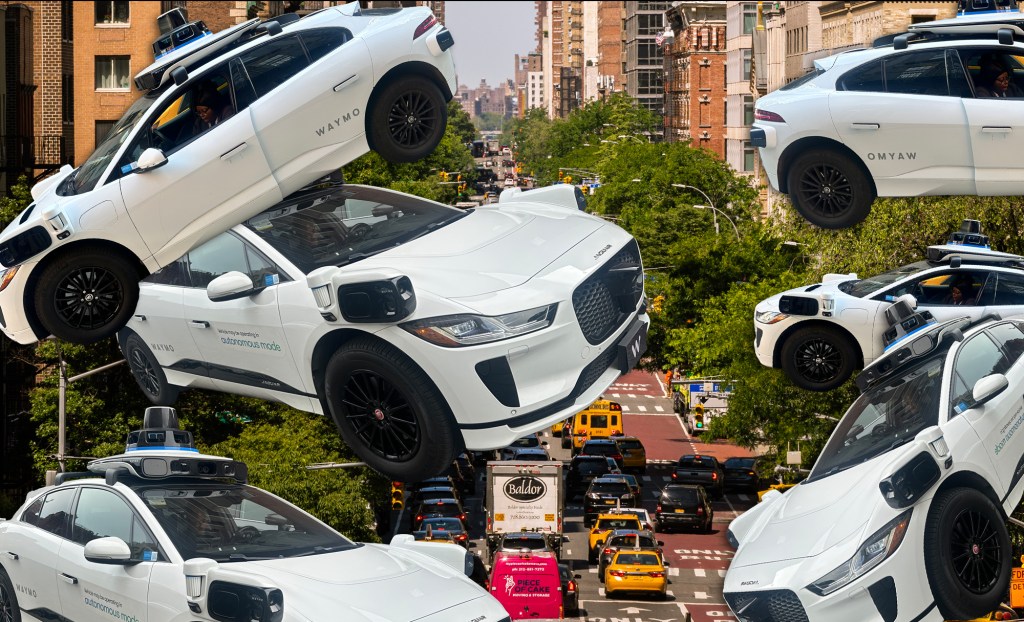
Are Waymo cars safer? Maybe. But will they make our streets and neighborhoods more livable? Way no.
If unleashed in New York City, autonomous taxis will dramatically increase the amount of congestion on our streets, according to a report released on Monday by the Sam Schwartz Transportation Research Program at Hunter College in collaboration with Open Plans.
The reason? Waymo cabs spend far more time driving around without passengers than comparable human-driven Uber and Lyft cabs. In California, where Waymo’s autonomous taxis have been operating and churning out trip data for years, a Waymo will travel 0.71 miles empty for every one mile. But in New York City, so-called high-volume taxis — Uber, Lyft and the like — drive empty for 0.49 miles for every one mile with a passenger.
That 14.8-percent gap would translate to tens of thousands of additional vehicle miles every single day.
The amount of additional miles depends on the extent to which robotaxis replace existing taxi trips — and the report offers a range. If robotaxis are deployed and only add to existing taxi trips, obviously, the additional number of VMTs will be much higher than if robotaxis slowly replace existing taxi trips.
Under both scenarios, VMTs increase. If 2,000 new autonomous taxis show up in New York City and there is no commensurate decrease in taxi trips, suddenly there will be 293,800 more vehicle miles traveled in New York City every day. No, that’s not epic, glacial congestion, but it is the equivalent of more than 3,750 trips around Manhattan every day.
In the more-likely scenario that robotaxis slowly replace human-driven Uber and Lyft trips, there will still be an increase in vehicle miles traveled because of that 14.8-percent higher “deadheading” rate for robotaxis.
“As it stands, replacing a HV-FHV with a robotaxi would increase VMT and congestion,” the report states.
But wait, there’s more: In California, robotaxis spend roughly 58 percent of their empty time in a parking space. But analysts at the Sam Schwartz program and Open Plans say it’s far less likely in New York that a robotaxi would be able to find an empty space between rides. The report states that for every 1-percent decrease in parked time, the robotaxi would experience a 1.5-percent increase in deadheading.
How much deadheading again depends on how few parking spaces are available to robotaxis: If, for example, robotaxis in New York were parked just 25 percent (vs. the 58 percent of the time in California), it would translate to roughly another 62,000 vehicle miles traveled every day in New York.
So the increase in traffic is not massive, but it’s still frustrating because deadheading is just dumb. “Deadheading is particularly impactful in urban areas,” the report states. “While an empty mile and an occupied mile impose similar per-mile costs on roadway congestion and safety, deadheading represents VMT added without any corresponding transportation benefit.”
Sara Lind, co-executive director of Open Plans, said her group’s report is not meant to be a condemnation of autonomous, but merely a wake-up call to their unintended consequences.
“While robotaxi technology is groundbreaking, the underlying reality perpetuates our current system: a focus on single-use vehicles over public transportation and active mobility,” said Lind, whose organization shares a parent company with Streetsblog. “Not only would robotaxis continue trends of increasing driving and congestion, they may very well exacerbate these issues. Cities should use this moment to update parking policies, explore fees on vehicle miles traveled, and pursue people-centered planning.”
Waymo pushed back on the report, saying that the company’s deadheading in California is “decreasing over time as we increase the efficiency and utilization of our fleet.”
“The premise put forward by the report — that the New York City [taxi] fleet could fully turn over to Waymo vehicles — is also inaccurate,” company spokesman Ethan Teicher said. “Waymo vehicles make up a fraction of the total ride-share vehicles on the road in the places where we operate, and that would also be true of New York City. For example, we have more than 3,500 vehicles in our fleet nationwide, whereas there are more than 100,000 for-hire-vehicle drivers operating in New York City alone.”
But Teicher did agree that the company is keenly interested in making sure its robotaxis will be able to store themselves at the curb rather than deadheading.
“Research has shown that Waymo vehicles’ ability to park at the curb when not serving a passenger is important for reducing empty VMT,” he said. “This study correctly identifies parking as a challenge in New York City, presenting an opportunity for renewed focus on municipal curb management. We’d be thrilled to share our experience with city leaders.”
After all, he added, Waymo’s business model is dependent on reducing empty models because unlike other taxi fleet, the company owns the vehicles in its fleet.
But even the company statement reminds anew that the robotaxi industry in general, as well as Waymo specifically, is a very small business right now.
“Waymo is like a rookie hitter who goes two for five in his first game and claims to be a .400 hitter,” Schwartz told Streetsblog. “Let’s see what he does over a season and lifetime. Waymo has driven about 200 million miles over past six years. Over that period, Americans alone drove almost 20 trillion miles, so Waymos made up just one-thousandth of a percent. Waymo may be a candidate for Rookie of the Year, but it is still a rookie!”

Read More:
Streetsblog has migrated to a new comment system. New commenters can register directly in the comments section of any article. Returning commenters: your previous comments and display name have been preserved, but you'll need to reclaim your account by clicking "Forgot your password?" on the sign-in form, entering your email, and following the verification link to set a new password — this is required because passwords could not be carried over during the migration. For questions, contact tips@streetsblog.org.