SCOUT’s Honor: Hochul To Expand MTA Program Pairing Nurses and Cops to Combat Mental Illness in Subways

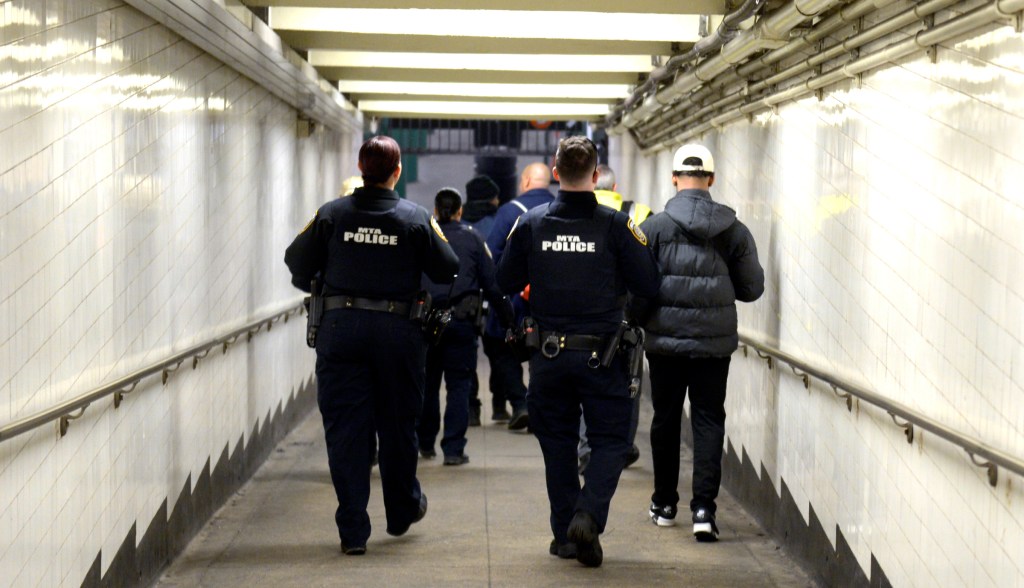
Gov. Hochul asked state lawmakers on Tuesday to expand a controversial MTA program that pairs up cops and nurses to treat and remove individuals with severe mental illness from New York City’s subway system.
Hochul wants to increase the number of Subway Co-response Outreach Teams — better known as SCOUT — from 10 to 15, which would provide enough personnel to proactively check up to 120 stations per day for people who are either severely physically ill or in the midst of a psychotic episode, according to officials. The MTA is currently capable of monitoring only up to 80 stations per day.
The governor did not specify the exact size of her spending request in the documents released alongside her State of the State address, but Streetsblog previously reported that each SCOUT team costs more than $1 million per year.
“On our subways, we’re committed to maintaining enhanced police patrols, we’ll install more platform barriers at 85 additional stations and expand our elite mental health units to get people in crisis off the trains and into care,” Hochul told state politicos and dignitaries during her annual speech in Albany.
Last year, Streetsblog revealed that existing SCOUT teams often take at least two hours to relocate a person in a mental health crisis from a subway platform into a hospital bed. The removal process involves so many steps — as many as 17 by one internal count — that sick New Yorkers frequently grow sicker and risk becoming a danger to themselves and others.
Another Streetsblog investigation showed how this dysfunctional system played out in real time at the Stillwell Avenue terminal in Brooklyn, where beat cops and poorly paid social workers ignored sick and homeless New Yorkers during an overnight shift.
The MTA’s internal review of its safety net — quietly conducted in the aftermath of the coronavirus pandemic amid a spate of horrifying attacks on the system — echoed the findings of Streetsblog’s investigation and spurred the creation of the SCOUT program.
The program trains MTA Police officers, links them up with city nurses and dispatches cop-and-nurse teams throughout the subway system to find New Yorkers who need help. The effort initially launched with two teams.

Officially, MTA brass touted the program as a way for first responders to safely interact with mentally ill individuals. Less officially, they acknowledged the SCOUT program made it far more likely that sick New Yorkers on the subway received help, by reducing the time it takes to admit them to a hospital and increasing the chance they remain there long enough to undergo a full evaluation.
Last week, straphanger advocates and good government reformers encouraged Hochul to grow the SCOUT program even more, to at least 20 teams.
“We believe that SCOUT will scale extremely well. If you expand it to 20 teams, it will be far more than twice as effective because it will generate positive systemic changes in New York City’s receiving hospitals, psychiatric ERs, case management systems, transitional housing and supportive housing,” three major groups — Reinvent Albany, the Regional Plan Association and the MTA’s in-house rider advocacy arm, the Permanent Citizens Advisory Committee — wrote in a letter to Hochul last week.
Under Mayor Eric Adams, New York City launched its own version of the program, PATH, which comprised specially trained NYPD officers in as many as five teams, depending on the day. However, the involvement of police officers — even those specially trained — has raised the hackles of civil libertarians.
Throughout his 2025 mayoral campaign, then-candidate Zohran Mamdani argued the police should be much less involved in mental health calls, which should be handed by a yet-to-be created Department of Community Safety. However, Hizzoner’s platform did not directly address if he would continue the PATH program, and its fate remains unclear.
City Hall did not immediately respond to questions about the program’s fate or about a timeline for considering its future.

Read More:
Streetsblog has migrated to a new comment system. New commenters can register directly in the comments section of any article. Returning commenters: your previous comments and display name have been preserved, but you'll need to reclaim your account by clicking "Forgot your password?" on the sign-in form, entering your email, and following the verification link to set a new password — this is required because passwords could not be carried over during the migration. For questions, contact tips@streetsblog.org.