Sustainable Transport Advocates Decry ‘Precision Scheduled Railroading’ After Ohio Derailment
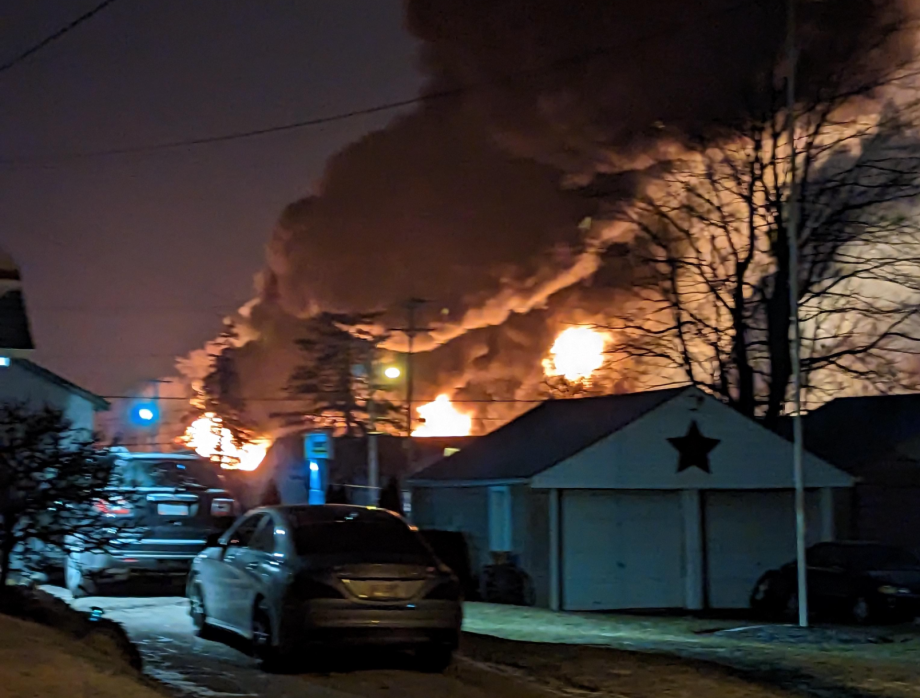
The ongoing debate over who’s to blame for a toxic Ohio train derailment is obscuring a more critical conversation about the freight rail industry’s tendency to put profits over safety, sustainable transportation advocates say — and DOT, Congress, and the rail industry itself must all play a role in unraveling the mess.
According to a preliminary report from the National Transportation Safety Board, an overheated wheel bearing likely played a significant role in the Feb. 3 derailment of a Norfolk Southern freight train in East Palestine that sent dozens of cars careening off the tracks.
No one was killed in the immediate aftermath, but five of those cars were tankers carrying polyvinyl chloride, an industrial chemical used in the production of plastics that’s linked to several cancers.
Moreover, because PSR emphasizes making trains as long as possible by combining delivery cars for many different customers, those rapidly inspected (perhaps too rapidly inspected) trains often include innocuous materials like sand and wheat alongside as many as 34 cars full of toxic materials like vinyl chloride, without meeting the threshold for being classified as “high-hazard flammable train,” which triggers additional safety requirements like decreasing the train’s maximum speed.
Some experts pointed out, though, that those requirements do not include electronically controlled pneumatic brakes, despite the fact that they can sometimes prevent derailments that less-modern systems can’t. (The Obama administration moved to make such brakes mandatory on hazmat trains, but the proposed rule was rescinded under the Trump administration before it could go into effect.) Nor do they require the use of safer, modernized tank cars that comply with a standard known as DOT 117, which Congress initially required railroads to phase in by 2025, until the deadline was pushed back to 2029.
Matthews emphasized that because the holes that Precision Scheduled Railroading has torn in America’s safety net are so complex and numerous, it will take all hands on deck to repair the damage — including to the reputation of the rail industry itself. He said high-profile disasters like East Palestine’s tend to fuel public misperception that trains in general aren’t safe — despite the fact that only a tiny fraction of of the 1,700 derailments that happen in the U.S. every year involve companies like Amtrak, which averages just 24 derailments annually. (Even freight rail companies, for the record, are significantly safer than freight truck outfits, which log 90 percent of all hazmat crashes and significantly fewer collisions with bicyclists, pedestrians, and other road users.)
“People think, ‘I’m not gonna ride Amtrak, it’ll derail!’” Matthews said. “This just creates a sense of doom around taking a train, which now we have to go out and dispel.”
My first piece of legislation in Congress is to force railroads like Norfolk Southern to operate more safely.
Today, @RoKhanna and I are introducing the DERAIL Act, which will tighten hazardous material restrictions and put safety first. https://t.co/G7Bvq0zh6W
— Chris Deluzio (@ChrisForPA) February 28, 2023
In a Feb. 21 memo, federal DOT officials committed to “pursuing further rule-making, to the extent possible under current statute” to require the pneumatic brakes, safer tank cars, stronger staffing rules, and other safety measures they say will be impactful, even if they might not have prevented the Palestine derailment.
The agency pointed out, though, that many of the most impactful safety reforms aren’t possible without outside help. Congress, for instance, are the only ones who can change the definition of what qualifies as a “high-hazard flammable train” and strengthen safety regulations on railroads that run them, and they’re also the only ones who can increase the maximum fines that DOT can levy when companies violate those regulations, which are currently capped at just $225,455.
House Democrats answered many of those calls in a bill introduced Tuesday called the DERAIL Act — but notably, lawmakers elected not to increase the maximum fine, which DOT compared to “a rounding error for a company that reported an astonishing record annual operating income in 2022 of $4.8 billion and has posted operating margins approaching 40 percent.”
Moreover, there’s no guarantee that the bill will even pass the divided Congress — or that the industry will step up when lawmakers don’t demand it. Norfolk Southern has made a vague commitment to “develop practices and invest in technologies that could help prevent an incident like this in the future,” but not to take the concrete steps that the DOT and advocates like Matthews are asking for, like providing paid sick leave to workers to help them from becoming exhausted and joining a “confidential close call” reporting program to protect safety whistleblowers.
“People say, will say, derailments are down, they’re not as bad as they used to be, no one was killed [in this disaster], and Precision Scheduled Railroading isn’t the problem,” Matthews added. “But come on: are we really going to say, ‘We’re just going to gas a small town once in a while, and that’s the cost of doing business?’ … We’ve got a get a handle on this as industry, and we’ve got to do it as soon as possible.”

Read More:
Streetsblog has migrated to a new comment system. New commenters can register directly in the comments section of any article. Returning commenters: your previous comments and display name have been preserved, but you'll need to reclaim your account by clicking "Forgot your password?" on the sign-in form, entering your email, and following the verification link to set a new password — this is required because passwords could not be carried over during the migration. For questions, contact tips@streetsblog.org.