POST-MORTEM: Car2Go is Car2Gone in 5 Cities
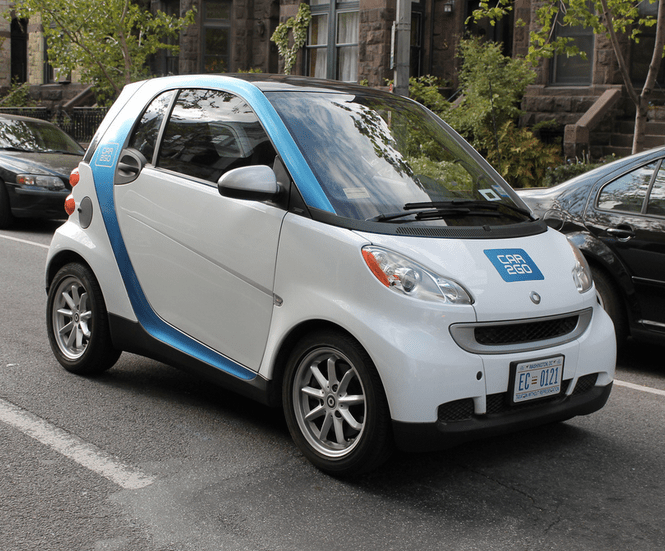
The largest car sharing company in the world is withdrawing from five North American cities after being squeezed at both ends of a volatile economy that has given passengers a multitude options to motor around their cities.
Car2Go and its parent company Share Now announced on Friday that the rent-by-the-minute Smart cars would leave Denver, Austin, Portland, and Calgary by Oct. 31, and pull out of Chicago by the end of the year because of growth struggles in those cities amid increased competition from fast-growing app-based taxi companies and micromobility ventures — as well as good old American rising vehicle ownership.
The shutdown stemmed from “a combination of low carshare adoption, high private car ownership rates, infrastructure and policy hurdles, and an underestimation of the amount of the resources necessary to make our service sustainable in a rapidly evolving mobility landscape resulted in the decision to close these cities,” Car2Go North America spokeswoman Kendell Kelton told Streetsblog.
That echoes what Share Now social media manager Maximilian Ehlers said on Friday in a company blog post that admitted the company “underestimated the investment and resources that are truly necessary to make our service successful in these complex transportation markets amid a quickly changing mobility landscape.”
You can say that again, said a spokesman for Portland’s Bureau of Transportation.
“We are sorry that Portlanders will lose a transportation option that helps people live without the expense of owning a car,” said the spokesman, Dylan Rivera. “As the birthplace of car-sharing and a hotbed of transportation innovation, Portland welcomes private sector investors to join us in creating affordable options that reduce congestion and pollution.
Instead the company, which has a fleet of 20,000 cars in 31 cities in North America and Europe, will focus on improving its customer base in Seattle, New York, Montreal, Vancouver, and Washington D.C., where Car2Go has been more popular, mostly because of lower car ownership in those cities.
“Although there are many players offering a wide variety of competing mobility solutions, the ultimate goal of every provider is to reduce the number of privately owned vehicles in big cities,” Kelton added. “We remain confident that this trend will continue, and we plan to explore new opportunities for car sharing as the research proves it is a viable solution for a more sustainable future.”
The app-based service has been providing short-term car rentals in North America since 2009, upending the car rental market comprised of major players like Hertz, Enterprise, and Avis, which acquired Zipcar, another timed rental car company, in 2013.
Pricing varies based on location — Car2Go charges $0.24 to $0.34 per minute for a smart car in Chicago and $0.35 to $0.45 per minute for one in New York.
Last year, the auto tech company boasted its best financial year ever with 25 million rentals and a 21-percent increase in membership to 3.6 million worldwide. Vancouver has the highest membership in North America with 192,000, followed by Calgary (134,000), Seattle (127,000), and New York (122,000), which was the fastest growing with a 41-percent increase in membership between 2017 and 2018, according to Car2Go.
But Chicago has had a far smaller base of customers by comparison with about 10,000 members and a fleet of 400 vehicles by last October, three months after Car2Go launched there. The company also dealt with service disruptions following a spate of vehicle thefts in April in which 21 people were charged for stealing 100 Mercedes-Benzes, although Car2Go said the crime wave wasn’t the reason the company was leaving the Windy City.
Car2Go had a lengthier presence in Denver, bringing 300 smart cars to Mile High City in 2013. But the company scaled back its fleet in several neighborhoods two years later, losing 8,000 members in the process. By 2017, Car2Go introduced Mercedes models to the mix for the city’s remaining 42,000 members and expanded the coverage area, but damage was done as other mobility competitors rushed into the market.
“What we’ve seen with Car2Go, and in the past with the likes of Enterprise, Maven, etc., is that these larger companies think this is a potentially lucrative space to enter, without realizing how tough this market actually is, and how increasingly competitive it is, especially with shorter trips,” Peter Krahenbuhl, CEO of the nonprofit Denver-based car share eGo CarShare told Streetsblog Denver. “I just hope that Car2Go exiting the market doesn’t result in more individual car purchases.”

Read More:
Streetsblog has migrated to a new comment system. New commenters can register directly in the comments section of any article. Returning commenters: your previous comments and display name have been preserved, but you'll need to reclaim your account by clicking "Forgot your password?" on the sign-in form, entering your email, and following the verification link to set a new password — this is required because passwords could not be carried over during the migration. For questions, contact tips@streetsblog.org.