Prospect Park Is Officially Car-Free Forever
As of this morning, Prospect Park is officially and permanently car-free, the culmination of 50 years of advocacy.
“Today, we are providing a great new year’s gift that recognizes the special place the park holds for so many other Brooklyn families,” Mayor de Blasio said in a statement. “Now as a safe refuge that has permanently removed cars, the park can expect to see even more people enjoying walking, jogging and bicycling on its beautiful loop road.”
Over two generations, car-free park campaigns had whittled down the hours when motor vehicle traffic was allowed from 24/7 access to two hours on weekdays from 7 to 9 a.m. The last segment where traffic shortcuts were permitted was the east side of the loop during the morning rush. DOT counts in 2017 showed that walkers, joggers, and cyclists on the loop outnumbered motorists more than 1,000 to 300.
After an eight-week trial last summer, this morning marked the first workday where the whole loop was off-limits to private cars on a permanent basis.
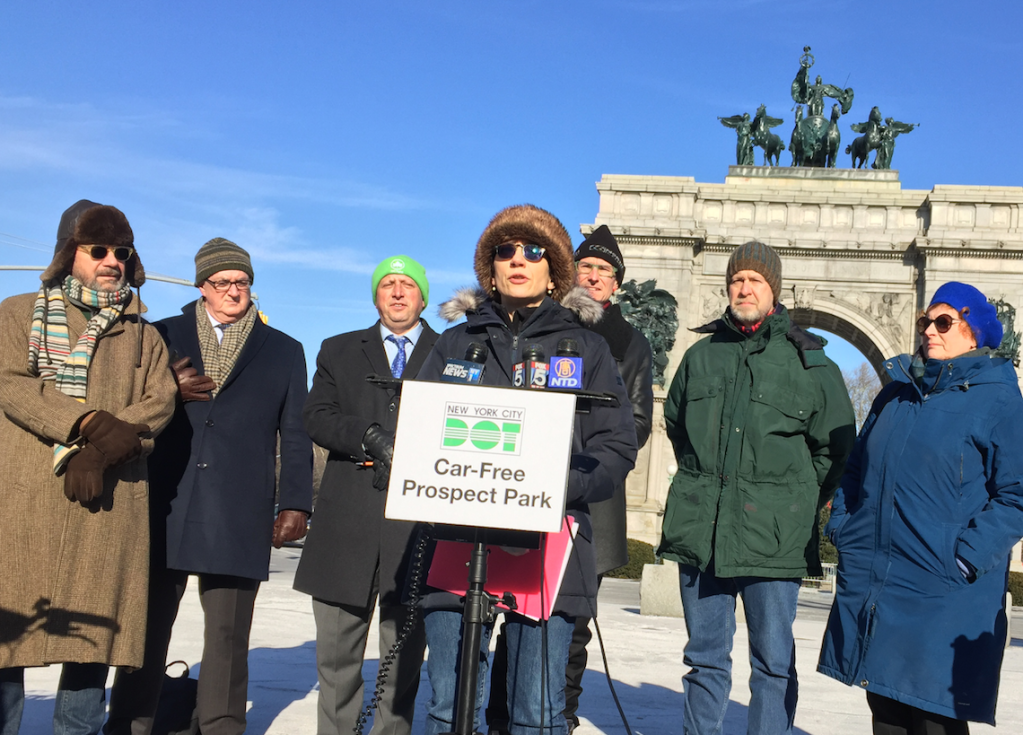
“The process has taken a number of years,” Trottenberg said at a press conference this morning at Grand Army Plaza. “We’ve slowly closed down drives, and slowly moved more and more cars out of the park.”
The first step toward a car-free Prospect Park came in 1967, when the city first prohibited motor vehicle access on the weekends. Throughout the 1990s and 2000s, Transportation Alternatives organized campaigns that collected tens of thousands of signatures in favor of making the park completely car-free, gradually winning more restrictions on when and where cars were allowed to intrude.
In 2003, then-Council Member Bill de Blasio participated in a bike ride with TransAlt volunteers in support of a car-free park. Trottenberg said the issue remained near and dear to the mayor. “He came in and, really, I think it was one of his goals as mayor, was to see ultimately that we get to a car-free Prospect Park,” she said.
While cars are prohibited, park entrances are not designed well to stop motorists from entering. It’s not difficult for drivers to nose through the metal fences. Just last month, a teenage driver critically injured a jogger at a time and location where vehicles were not allowed.
Now that the park is car-free all the time, Trottenberg said DOT plans to ensure “signage and barricades” do a better job of keeping drivers out.
Today’s milestone in Prospect Park also sets an important precedent for other major parks throughout the five boroughs that still have traffic shortcuts slicing through them, including Central Park. Despite the unanimous support of nearby community boards and massive petition campaigns that collected 100,000 signatures, much of Central Park below 72nd Street is marred by private motor traffic. This morning, Trottenberg was noncommittal on making Central Park car-free, saying only that the city was “looking into” it.

Read More:
Streetsblog has migrated to a new comment system. New commenters can register directly in the comments section of any article. Returning commenters: your previous comments and display name have been preserved, but you'll need to reclaim your account by clicking "Forgot your password?" on the sign-in form, entering your email, and following the verification link to set a new password — this is required because passwords could not be carried over during the migration. For questions, contact tips@streetsblog.org.