The Top 10 Regions Where Jobs Are Within Reach for Transit Riders

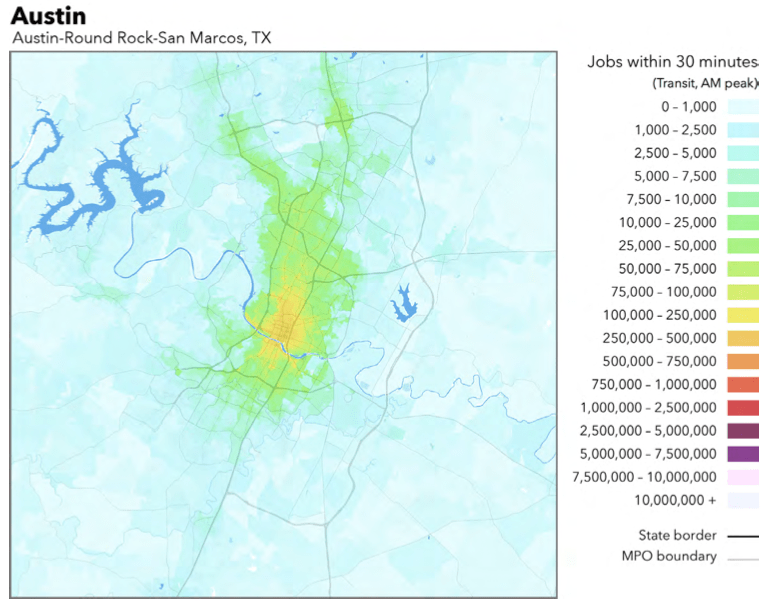
How easy is it to access jobs via transit? The answer says a lot about economic fairness in your region, and whether employment opportunities are fully available to people who can’t afford the expense of owning, maintaining, and fueling a car.
Researchers at the University of Minnesota have been working on measuring transit access to jobs as part of their broader “Access Across America” project, and they just came out with new rankings for 49 of the nation’s biggest metro regions.
Using detailed data on population, employment, and transit schedules, the rankings weigh how many jobs residents can typically access via bus or train in a given amount of time. The more jobs are within reach of more people in less time, the better a region’s rank will be.
Among the metro areas that provide the best job access by transit, there aren’t too many surprises.
Best job accessibility by transit (metro area)
The top 10 list is unchanged from the previous year, notes David Levinson, a civil engineering professor David Levinson who helped devise the rankings. But there were some shifts. “In all, 36 of the 49 largest metros showed increases in job accessibility by transit,” Levinson writes.
The list below shows the regions where transit access to jobs improved the most between 2015 and 2016. Only one of these cities — Seattle — has made notable changes in transit service, so the improvements are probably related to changes in the location of jobs or housing that made existing transit service a better fit for more commutes. It’s an important reminder that making transit service useful depends to a large extent on land use decisions.
Biggest improvement in accessibility
- Cincinnati (+ 11.23%)
- Charlotte (+ 11.02%)
- Orlando (+ 10.83%)
- Seattle (+ 10.80%)
- Providence (+ 10.65%)
- Phoenix (+ 7.51%)
- Riverside (+ 6.59%)
- Milwaukee (+ 6.53%)
- Hartford (+ 6.44%)
- New Orleans (+ 6.18%)
Check out the full report for detailed data about how your region performs.
More recommended today: Observational Epidemiology critiques media coverage of Elon Musk’s Hyperloop. And Seattle Met explains a proposal moving forward in Seattle for “sweeping” upzoning that would address the city’s housing shortage.

Read More:
Streetsblog has migrated to a new comment system. New commenters can register directly in the comments section of any article. Returning commenters: your previous comments and display name have been preserved, but you'll need to reclaim your account by clicking "Forgot your password?" on the sign-in form, entering your email, and following the verification link to set a new password — this is required because passwords could not be carried over during the migration. For questions, contact tips@streetsblog.org.