“Distracted Walking” Is a Distraction From the Real Problem

Laws to penalize the act of “distracted walking” are rearing their ugly heads across North America.
Honolulu started the trend this summer by banning the act of looking at your phone while crossing the street, which local legislators in other cities took as inspiration.
The next domino to fall might be the Canadian province of Ontario, where Yvan Baker of the Etobicoke Centre provincial electoral district has proposed legislation cutely named “Phones Down, Heads Up.”
The problem with these laws is that they don’t target a genuine public safety threat. And Mike Boos of the Waterloo-based Tri-Cities Transport Action Group has the numbers to prove it.
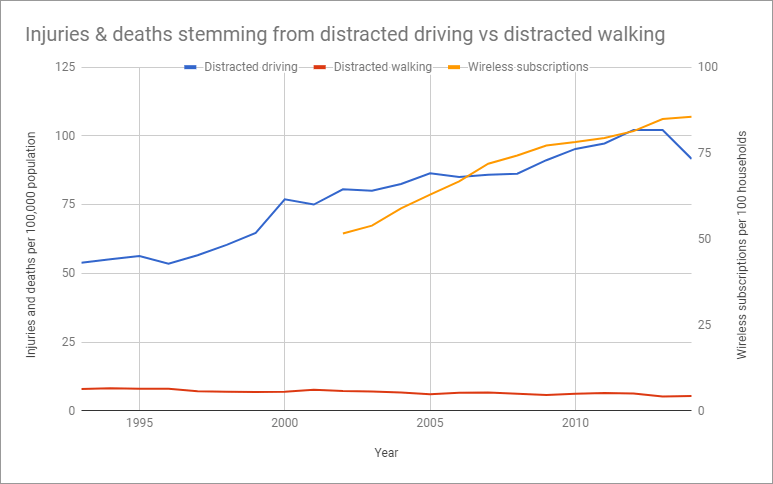
Boos crunched data from the Ontario Ministry of Transportation, and the results plainly show that the rise in mobile connectivity tracks with an increase in distracted driving crashes. There is no sign that distracted walking is a significant or growing factor in collisions, Boos writes:
Contrary to claims by MPP Baker, collisions stemming from distracted walking are actually decreasing in Ontario!
How is it possible that, in spite of frequent sightings of people looking at their phones, distracted walking collisions are relatively infrequent? Some research suggests people slow down their walking when they’re looking at their devices, enabling them to avoid obstacles and not walk into trouble inadvertently. This compensation for risk isn’t foolproof, but it does a lot to mitigate the effects of being distracted.
Closer to home, the Region of Waterloo annual collision report indicates that pedestrians have been ‘inattentive’ in about 15% of collisions over the past five years, though that doesn’t mean they were found to be at fault in all such cases (or that they were looking at phones – it could just mean they didn’t look both ways). Indeed, in only 14% of collisions was a pedestrian crossing without the right-of-way.
By contrast, in only 23% of collisions with pedestrians was the driver found to be driving properly. If a driver makes an mistake and speeds into your path, it’s not clear how having your cellphone tucked away will change the outcome. If the goal is to save lives, reducing or mitigating the effects of driver error seems like a much more effective place to start.
Regardless of what has greater impact, MPP Baker indicates that if just one life were saved by his bill, he’d feel it was worth it. The deterring power of fines is brought into question when we look back at that first chart and recall that Ontario introduced its first distracted driving law back in 2009. If there’s any evidence of lives saved by that legislation, it’s not in the numbers – injuries and deaths keep climbing until sometime around 2012. And if self-preservation isn’t sufficient motivation to pay close attention to the task of crossing the street, what’s the remote risk of a $50 fine?
People walking already have a clear incentive to pay attention around cars — self preservation. The harm of legislation like Baker’s is that it will add a new pretext to stop, harass, and fine people on foot without making anyone safer.
More recommended reading today: Greater Greater Washington lists five street signs that are really giveaways that a street has been poorly engineered. And Bike Portland writes about Tuesday’s vehicular attack in Manhattan and how we’ve allowed the threat of deadly driving, intentional or otherwise, to saturate our streets.

Read More:
Streetsblog has migrated to a new comment system. New commenters can register directly in the comments section of any article. Returning commenters: your previous comments and display name have been preserved, but you'll need to reclaim your account by clicking "Forgot your password?" on the sign-in form, entering your email, and following the verification link to set a new password — this is required because passwords could not be carried over during the migration. For questions, contact tips@streetsblog.org.