An Interview with Central Park’s Most Storied Competitive Cycling Club
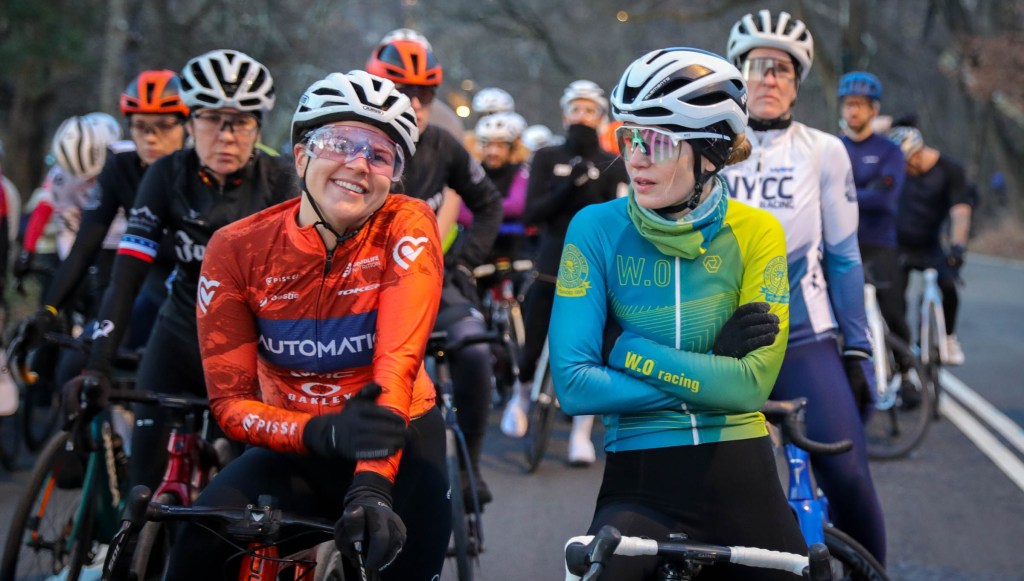
The Century Road Club Association is the oldest bicycle racing club in the United States of America. Founded in 1898, the CRCA’s volunteer members have trained and held cycling races in Central Park for more than a century. Both the city and the Central Park Conservancy consult with the club to develop and refine the park’s rules for cycling and ambulating around the main loop.
The recent deaths of Richard O’Brien and Douglas Adams have placed those rules under intense public scrutiny. To discuss these regulations, and the broader situation in Central Park, Streetsblog recently sat down with CRCA’s president, Emily Singleton, and its public relations director, Lucie Vágnerová.
This interview has been edited for length and clarity.
Streetsblog: How long have both of you been cycling in New York City?
Lucie Vágnerová: I moved to New York when I was 21 in 2009. I wasn’t riding a bike here at first. I was a runner, and I ran in Central Park multiple times a week. Then I started rollerblading, and then I got a road bike. I started racing with the CRCA, because it was the most affordable way for me to race as a graduate student on a stipend. I’ve experienced Central Park from just about every angle, and it really shapes how I think about this conversation.
Emily Singleton: I moved to New York at a similar time, in 2011. I worked in a bike shop. I didn’t start competing until a few years later. I commuted daily — I was a commuter for most of my first cycling interactions in New York. Then I started training in Central Park. At first it was just one loop at a time, and then I progressively did more loops, and did them faster.
Streetsblog: Lucie, you mentioned that you got a road bike. What does that mean, exactly?
Vágnerová: I grew up in the Czech Republic, which did not have very smooth roads at the time, so I was on a mountain bike. It had thicker tires that are a little more knobby. That’s what I grew up on. And when I was in my early 20s, I received a hand-me-down road bike, and then I got a cheap road bike from a shop downtown. These were my first bikes with drop handlebars — the curved ones that go under — and skinnier tires that roll really smoothly on a road surface.
Streetsblog: Got it. I asked because, when I first think of the term road bike, I think of an off-road bike, where it’s super heavy-duty. But that’s not what I see in Central Park. When did both of you join the Century Road Club Association?
Singleton: I think I joined in 2014.
Vágnerová: I’m pretty sure I joined in 2013.
Streetsblog: There are a lot of these groups, at various levels of formality, where people ride bikes in Central Park and affiliate with each other in some way. Is your organization sort of similar to that, or are they unique in a certain way? What would you say distinguishes the CRCA?
Vágnerová: The CRCA is pretty unique in that it is a volunteer-run non-profit that organizes accessible and affordable bike racing series in Central Park. It relies on its members to marshal those races to ensure safety, and members receive free skill sessions so they can be safe and fast on their bikes. It’s a whole ecosystem unto itself. It’s not a brand. It’s not a group ride. It’s its own community.
Streetsblog: This ecosystem’s activities — are they primarily in Central Park, or are they elsewhere as well?
Singleton: We’re based in Central Park. We have a few events outside of the park, but our racing series is in Central Park.
Streetsblog: We were talking a little bit about this over email, Emily, about the characteristics of Central Park that make it so ideal for competitive cycling. Could you speak to that — why this ecosystem prefers Central Park?
Singleton: CRCA has been around since 1898. A lot of it predates us. It’s always been a membership club with a close relationship with the Central Park Conservancy and New York City Parks, which is kind of how we got grandfathered into race dates and being able to exist as an organization based in Central Park. We always say that it’s a privilege to have access to Central Park. It’s a beautiful park. It has this amazing rolling terrain and a couple of steeper hills. In the spring, you really can’t beat the beauty of the first bloom in Central Park. It’s really special. It’s a six-mile loop, car-free since 2018, which is incredible. There are just so few car-free spaces and continuous loops where you can ride your bike for fitness.
Streetsblog: Apart from Central and Prospect Parks, are there others? There’s the Velodrome in Queens. Are there other loops like that, at least in the five boroughs?
Vágnerová: Not car-free loops. That’s another thing that makes Central Park amazing. It is the most accessible spot for people — not just from the city, but from the outer boroughs, too — to meet up. A lot of cyclists will come in from Queens, from Brooklyn, from the Bronx, and meet on a group ride in Central Park to get fitter, train and potentially race with the CRCA.
Streetsblog: Got it. Now, both of you have been with the CRCA in Central Park for more than a decade. Can you tell me about any changes you have seen? Obviously, the most dramatic change is the removal of cars in 2018. But I’m curious, given your perspective over time, what has cycling become? Has it gotten worse? Has it gotten better? Just in terms of the experience of cycling in Central Park.
Singleton: In the COVID years we saw a boom of people using the park. We had such limited activities, so people went outside more and you just saw more crowding in the park. Just more people using it. It was a dramatic increase in usage of the park. And ever since then, it stayed pretty busy. Which is great! It’s an amazing space to have and to share. But we have to figure out how to co-exist with an influx of people with varying knowledge of the rules.
Streetsblog: Got it. Have you seen any changes, Lucie?
Vágnerová: I would echo what Emily said here. The removal of cars was a massive change, and cyclists were instrumental in that. Since the pandemic, it’s been amazing to see the park get busier. As much as it gets crowded and occasionally chaotic, it’s awesome to see people exercising, walking and hopefully mostly feeling safe. People walking to work across the park. Kids learning how to ride a bike. This is a good thing. And we are here to be partners in making the park safer.
Streetsblog: I want to talk about the facts on the ground in Central Park — the tactical reality of cycling around there. Because I did that this morning. I was on an electric Citi Bike, so I did not get the full experience of competitive cycling. But I figured out that there was a walking and running lane, a cycling lane and a shared path. What was it like before the redesign? And what has it been like after?
Vágnerová: I don’t know if I can accurately pull this out of my memory. I’ve always known — no matter how wide it is — not to go into the runner’s lane. That’s rule number one. Treat that like it’s a wall. In the CRCA, we know this is a busy park. We’re not just winging it. We have a set of rules we adhere to.
Streetsblog: That’s fair.
Singleton: It didn’t feel like a drastic redesign to us. The main points, if I recall correctly from our conversations with the Parks Department and the Conservancy, is that they removed the focus from car lanes and made it a little more pedestrian and cyclist friendly. They also changed the stoplights, so instead of red, yellow and green lights, most of the stoplights around the park now flash yellow to yield to pedestrians.
It would have been great if the redesign rolled out along with a program for educating people about how to interact with the park. The new stoplights can be confusing because you don’t really see these constantly flashing yellow crosswalks anywhere else in the city. If the expectation is for pedestrians to be able to cross as soon as they come up to the light, it can be more dangerous for them if a passing cyclist doesn’t see or acknowledge them.
Streetsblog: Both of you cycle in Central Park. This is going to sound like I’m a toddler, but: How does that work, exactly? You get on your bike, you clip in and then you start pedaling. Again, forgive my child-like curiosity here, but what is happening when you’re pedaling and gaining speed? Are you trying to obtain resistance, and work out the muscles that are required to excel in competitive cycling? Are you trying not to work? I guess I’m asking, what is going through the mind of a cyclist in Central Park?
Vágnerová: You know, I have been asking myself this question for one and a half decades. Every ride is different. Just like in every endurance sport, we spend most of our time doing pretty slow rides, where you might be in conversation with the person next to you, and you’re not even breathing that hard. You’re just enjoying a nice morning and getting your cardio. You’re building an engine. And then there might be a couple times per week where you deliberately go faster — whether it’s for bursts of 30 seconds or for 20 minutes at a time. Road bikes have gears, so as you go faster, you shift into a gear that allows your legs to spin at the same rhythm. You’re putting out more power, you stay in a comfortable gear, and you have control of the bike.
Streetsblog: When a cyclist is trying to get some speed, in the context of the CRCA rules, what is that conversation like? Do members typically use speedometers? Is that something that’s on their mind? Or is it seen as more of a muscle-memory thing, where you’re not necessarily measuring speed beyond whatever time you’re trying to achieve?
Singleton: Most competitive cyclists have computers that show how fast you’re going. But you’re not really training for speed when you’re doing workouts. You are focusing on power or heart rate or your own perceived efforts. Speed comes with that, and speed depends on the terrain. There are parts of Central Park where — even without pedaling on the downhill — you could easily go 20, or 25 miles per hour. Particularly on a Citi Bike, since it’s heavier, you pick up a lot more speed downhill. So even on an easy ride, where you’re riding at a steady pace, your speed will just fluctuate throughout the terrain. It might be 10 miles per hour uphill, 20 miles per hour downhill — but, again, that’s not really what you’re training for. When you’re racing, you’re racing for speed, but when you’re training, it’s just a byproduct.
Vágnerová: I would add that the speedometers on our bikes are really small. We shouldn’t be looking at them when we ride. One way to be unsafe is to be checking your speed at all times. I recently fell into running a junior team, and I tell these kids all the time: You don’t need to be looking at your computers. Speed is a data point you can study after. We shouldn’t be, as cyclists, checking our speed much during a ride.
Streetsblog: When you are cycling, and trying to be mindful, do you account for the location of crosswalks when training and potentially gaining more speed?
Vágnerová: Absolutely. The loop is not one place. There are definitely hot spots. The north of the park is not the same as Tavern on the Green, for example. And again, we have real systems in the CRCA that we push out to members, so that they educate themselves about how to be safer in the park. Train between the hours of 6 and 8 AM. Don’t bring more than 12 people to a group ride, so there aren’t massive trains of cyclists. If you’re riding a little slower, stay to the left. If you’re riding a little faster, stay to the right. Be respectful of every park visitor. Be mindful of the situation that is unfolding around you at any given moment. This messaging, this protocol, was developed together with the Parks Department — right, Emily?
Singleton: Together with Parks and other cycling clubs like NYCC and Kissena, yes.
Vágnerová: We try to be culture leaders. Being role models in the park ultimately contributes to making the park safer in a pretty meaningful way.
Streetsblog: I want to talk a little bit about my ride this morning, just a little bit more. I got to the park around 10:30 AM. It was just like a dream. It was perfect weather, 77 degrees in October. The leaves were turning. It was a weekday, so it was not that crowded. The impression I got, at least from my slice of the loop, was that pretty much everyone was more or less well-behaved. There was some misbehavior. I saw two people who appeared to be delivering food go too fast. Are you familiar with punish-passing?
Vágnerová: No.
Streetsblog: It’s where a driver deliberately comes too close to a cyclist in order to intimidate them. I wouldn’t accuse those people of punish-passing, but they came too close for it to be immediately distinguishable from it. I saw them and a few road cyclists go through a blinking yellow intersection when there were pedestrians at it. They were on the opposite side, but they still went through.
I want to hear your thoughts on this. How do you feel about the etiquette of various cyclists and pedestrians? After looking at the CRCA’s schedule, I feel like the situation is such that there are a small number of road cyclists or competitive cyclists who are not so conscientious and simply don’t want to practice at that times that your group recommends. They don’t care so much about conflicting with pedestrians.
So instead they ride during the day. That means that regular park visitors and tourists are most likely to see cyclists who are most likely to disregard the rules of the road. Just talking with you, and knowing a bunch of other people who are competitive cyclists, it seems like they are generally upstanding people, but it also seems like there is a smaller contingent who enjoy competitive cycling but choose to do it when the park is much busier.
Vágnerová: Cyclists should not be running lights, even blinking lights, if there are pedestrians trying to cross. That’s our position, and that’s how we behave when we’re in the park. Having more cyclists model that behavior is always going to be a good thing. But I feel for pedestrians when a cyclist cuts in front of them.
As for my personal experience of Central Park, a few things stand out as huge safety hazards. One of them is bikes — road bikes, delivery vehicles, mopeds, Citi Bikes — going the wrong way. That’s a huge safety risk. I’ve seen so many sticky situations resulting from that. The second is off-leash dogs. That’s gotten worse in the last couple years. And the third one is folks not treating the bike lane and the shared path as an active roadway.
There are vehicles on that drive. There’s certainly cyclists going fast, and sometimes runners and tourists will have earbuds in, and they turn into the roadway as if it’s a pedestrian lane, and it’s not. Rules matter, but many of these issues are better solved with communication than policy that the most reckless people are, unfortunately, not going to follow anyway. I think these are communication and culture issues.
Streetsblog: What would you like to see happen in Central Park? For example, I’ve been talking with people about the idea of adding more pedestrian underpasses, more terraforming to reduce pedestrian/cyclist conflicts and create better sight lines. When I was riding the loop, I remember thinking, that tree needs to be trimmed or this curve should be regraded. I’m sure there is a laundry list of individual fixes. But from the broadest point of view, what do you want to see happen in Central Park?
Singleton: We were included in the 2024 Drive Safety Study with the Conservancy and the Parks Department. In those conversations, we brought up things like making the roadway outside of the park more bike-friendly, so that there are two-way protected bike lanes on every side of the park. You would get less people going backwards on the drive.
Streetsblog: And the transverses, right?
Singleton: Yeah. Just making it easier for people who are currently commuting through the park to do so safely outside of the main loop. It does add extra congestion into the park. People are using it for fitness and hobbies, and people are using it for commuting. The e-bikes are fast. They have places to be. It can be alarming when they come close to you. It would be great if there were a separate path for these purposes.
Another one is just education in general. I don’t think people realize that there are archways under the drive and how to get to them. There are plenty of ways to cross the drive without actually crossing the drive. If you are intimidated by the traffic, there are pathways under the drive that take you to the center of the park — but I don’t know how people find those if they’re not looking for them.
Vágnerová: They always seem really dark to me. I think that’s part of it. People might be like, What is this dark cavern? Where will it take me?
Streetsblog: And the movie Home Alone 2: Lost in New York, which depicts those arches as very menacing. I believe it’s a recurring trope on Law and Order: SVU, too. That’s where bad things happen. There’s this mythology in New York City — especially among the good-government, civic-booster types — about the historical brilliance of Calvert Vaux, the architect of Central Park and Prospect Park and Forest Park. There’s this idea that he created this masterpiece. And I’m willing to admit that it was a masterpiece at the time it was built, and for many decades after that, but it does feel like the current form of Central Park, and frankly Prospect Park as well, is approaching the limitations of the original vision.
You know, this idea of a huge park where everything and everyone courses through itself, right? When you ride a bike, you ride it directly next to and between sports fields, forests, a reservoir — you have this amazing tour of the park. The loop really winds through everywhere. How radical do you think we need to get about this? Or do you think that we can tweak the existing form in such a way that it remains recognizable while still keeping people safe?
Vágnerová: You can fact check me on this, but I feel like we’re already very far from the original intent of the design. The original design didn’t want Central Park to be for sports at all — and now there are sports fields and cyclists and runners training for the marathon. The marathon goes through there. As far as I know, the original design was supposed to provide a refuge from the city — pastoral, soft and calm. This was where you go to chill out and definitely not exercise or strain yourself in any way. So we are working with a different population of people with different needs, with different desires in life. This is a really stressful city, and having a place to work on your fitness, get your heart rate up, and get together with friends is so, so important. We should do everything we can to do that in a safe and fun way.
Streetsblog: All of this seems very fixable. I am coming around to your idea about education and communication. And putting a lot more thought into the signage around the park, which was not as thoughtful as I expected it to be. The way people have been talking about cyclists in Central Park — especially the people who are more vitriolic — creates the impression that some of these cyclists are encountering crosswalks for the first time.
But it seems more accurate to say that that is a small number of lone-wolf cyclists who are not as courteous as the members of organized groups that can disseminate information and enforce rules on their members. I don’t know if a larger entity could intervene in some way, but I am curious about your vision for the education and communication component. Do you think that is a responsibility of the Parks Department, or do you think that’s a responsibility of the Conservancy, or perhaps Mayor Mamdani? What do you think?
Singleton: To be honest, the lines of responsibility for anything in Central Park are pretty blurry to me. And I say that as someone who interacts with them regularly. If we need something, we email both Parks and the Conservancy. They’re both very responsive and engaged, but I don’t always know who will reply. It’s hard to place the onus on one particular entity, especially when it is that blurry.
Personally, I don’t know why there isn’t more signage — particularly in areas with a lot of dogs — conveying the message that off-leash dogs are not allowed on the drive at any time of day. That still seems to be a confusing rule to many. That could have mattered when an unleashed dog killed Douglas Adams on the drive.
There are a lot of common-sense rules for how to interact with the park. With the redesign, it’s pedestrians in one lane, then slower cyclists, then faster cyclists and cars. It would be helpful if more people understood that. The only hint of this structure is that the far right lane has the sharrows, and if you interact with the streets of New York as a cyclist, you understand that sharrow means faster and that you’re sharing it with cars. If we had more people following these understood rules — you pass on the right, you slow down when you’re closer to pedestrians — there would just be less chaos overall, and it would be easier to spot the outliers and easier to interact more safely with the park.
Streetsblog: Got it.
Singleton: You mentioned vitriol earlier. It does tend to get vitriolic. And it is disappointing that we all seem to be dehumanizing each other in these conversations. We are a cycling club. Our hobby is cycling for fitness. We are on these bikes that go fast, but we genuinely care about the safety of other park users, and we interact with the park in a way that puts care first. If everyone can do that, we will have a safer park. We have such limited space here in this gigantic city. It’s such a gift to have Central Park. We’re all partners in this.
Vágnerová: I could not agree more with that. When a collision happens, it’s also our bodies at stake. As you said, I think there are a minority of cyclists that have a radically different risk tolerance and a way of interacting with public space and those in it. But we are at risk too, and all of us in the CRCA have been in Central Park on foot as well, interacting with cyclists as pedestrians. All of us have also been vulnerable in traffic. I just spent six weeks off the bike because I got doored by a car on New York City street. I spent a lot more time in the parks as a pedestrian and a little bit as a runner. And so I’ve been thinking about this conversation a lot more. How do I interact with cyclists when I’m on foot?
Streetsblog: Did either of you have any questions for me? And it’s okay if the answer is no.
Singleton: As a person who mostly interacts with Central Park as a pedestrian, did you have any preconceived notions coming into this that have maybe changed?
Streetsblog: Not entirely. There are a few cyclists I work with. One, her name is also Emily, and I have another colleague in the same office but at a different organization. His name is John Kaehny. He often walks in with his full cycling kit.
We’ve been talking a lot about all of this, especially with Emily. And I really, really appreciate and have directly witnessed the degree to which she has tried to balance her love of cycling in Central Park with this internal family drama within the livable streets movement about how exactly we want to reconcile our interest in Vision Zero with cyclists who move quickly in park settings.
I expected the same degree of careful thought that both of you demonstrated here. I think with that there’s a real difference between the people that I know in my work life, who are competitive cyclists and whom I love, versus the people I see whenever I go into Central Park or Prospect Park. They’re moving very quickly, and I’m a pedestrian, so it’s natural to feel threatened. So to answer your question: no. I had high expectations. I assumed that you would be wonderful to interview. And I think you fulfilled that.

Read More:
Streetsblog has migrated to a new comment system. New commenters can register directly in the comments section of any article. Returning commenters: your previous comments and display name have been preserved, but you'll need to reclaim your account by clicking "Forgot your password?" on the sign-in form, entering your email, and following the verification link to set a new password — this is required because passwords could not be carried over during the migration. For questions, contact tips@streetsblog.org.