Eyes on the Street: Brooklyn Bridge Cyclists Finally Get A Grand Manhattan Gateway
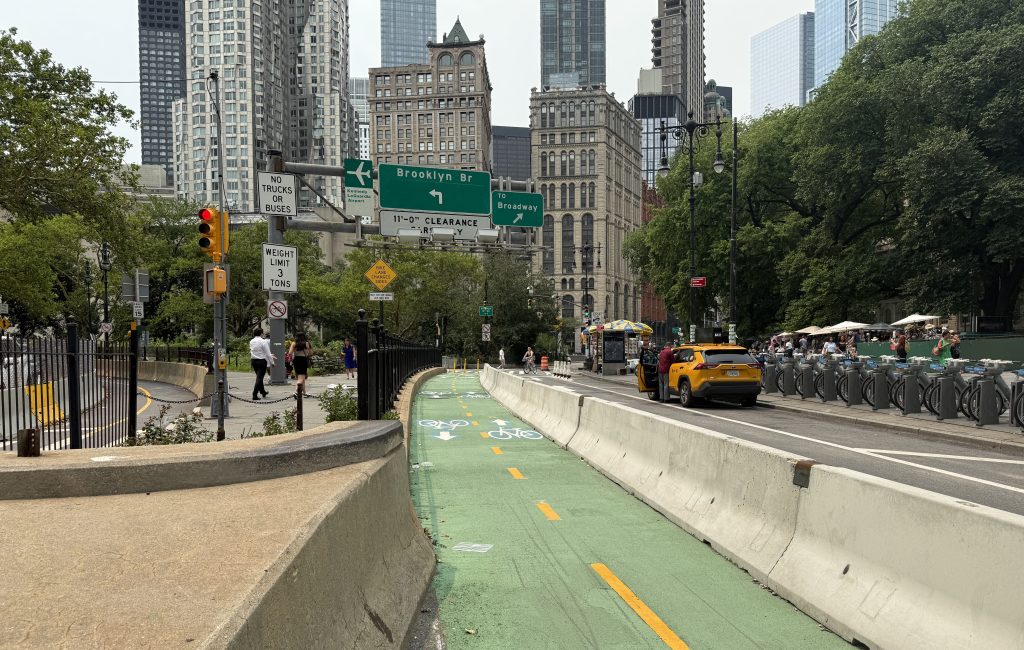
The Department of Transportation has finished its project to give cyclists and pedestrians their own space at the Manhattan entrance of the Brooklyn Bridge, but there are still some holes in safety for both users.
The Adams-era proposal is a finishing touch on the fully protected, two-way bike lane on the bridge, which originally dumped Lower Manhattan-bound cyclists into an often-crowded mini-plaza at the foot of the bridge on the Manhattan side.
The bridge gets a lot of use by cyclists and pedestrians, especially since the city installed a dedicated bike lane on the bridge in 2021. On average, nearly 30,000 pedestrians and more than 5,600 cyclists use the bridge’s respective paths everyday, according to the Office of the Mayor.
Now, downtown-bound cyclists or bridge-bound cyclists coming from the south get their own protected lane.
So how is the tweak working? We put some eyes on the street:
First, what was wrong?
Before DOT installed the new portion of the Centre Street lane, cyclists exiting the bridge who wanted to head downtown had to make a sharp, hairpin turn onto the pedestrian-dominated Brooklyn Bridge Promenade and cycle or walk through the crowds of pedestrians entering and exiting the Bridge’s pedestrian path, along with the other cyclists trying to get onto the bridge’s dedicated bike lane.
“You were being deposited right as cyclists are trying to get on the bridge crossing you, and then to get around them, you’re biking into pedestrians,” said Emily Jacobi, the Manhattan organizer for Transportation Alternatives. “So, there was no way to actually safely get off the bridge and onto Centre Street.”
If cyclists wanted to continue traveling down Centre Street, to the connecting painted, two-way bike lane on Park Row, they had to join masses of pedestrians trying to use the same sidewalk exit and entrance ramp to cross the street.
The new design
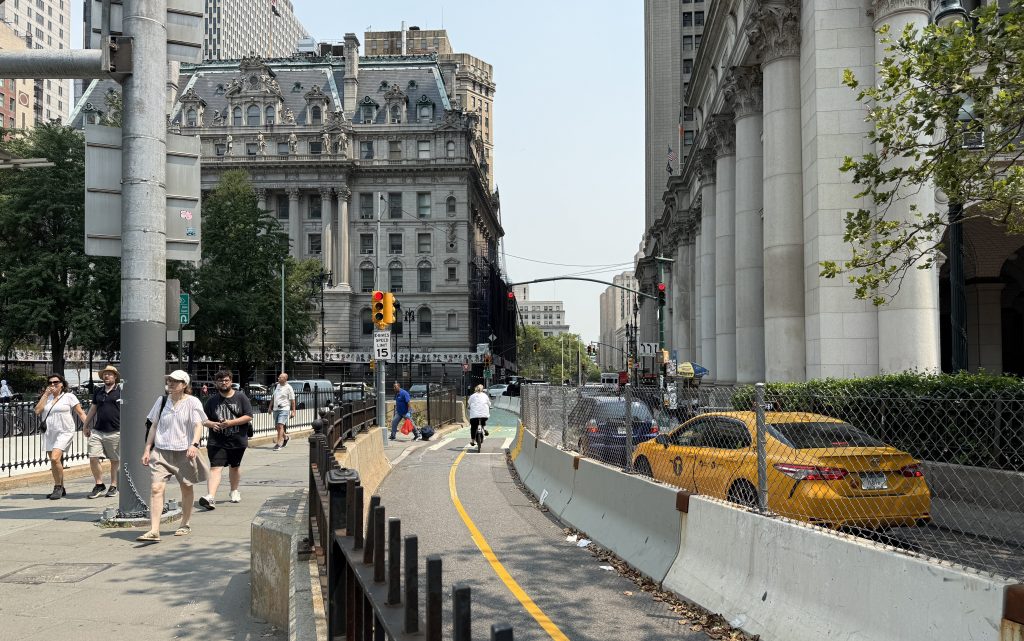
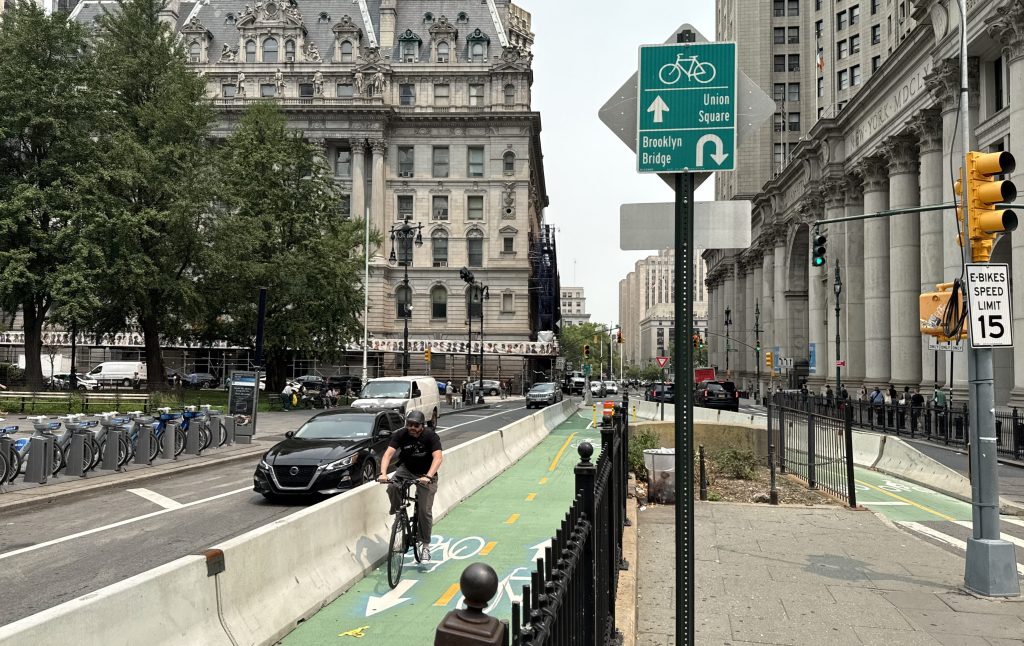
The lane coming off the bridge itself is unchanged, as the picture above shows.
But cyclists coming off the bridge now have two options: they can continue northbound through the intersection with Chambers onto the existing protected bike lane on Centre Street.
Or if they want to go towards Lower Manhattan, they can make a new hairpin turn at the new bike-only intersection and onto the new protected south-bound lane repurposed from a superfluous bridge-bound car lane.
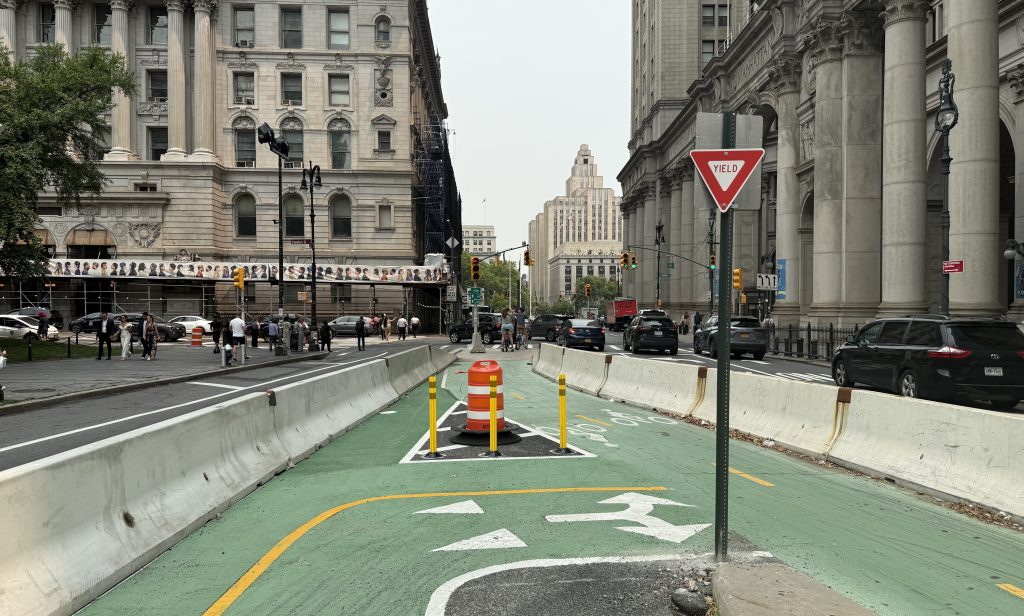
The protected lane extends from the hairpin turn to the intersection at Centre Street and the Brooklyn Bridge Promenade, where pedestrians and cyclists used to have to fight for space to cross the street safely.
Now, cyclists have their own crosswalk — painted green and situated next to the pedestrian crosswalk — that connects the east-side bike lane to one that continues south down Park Row on the west-side (photo below):
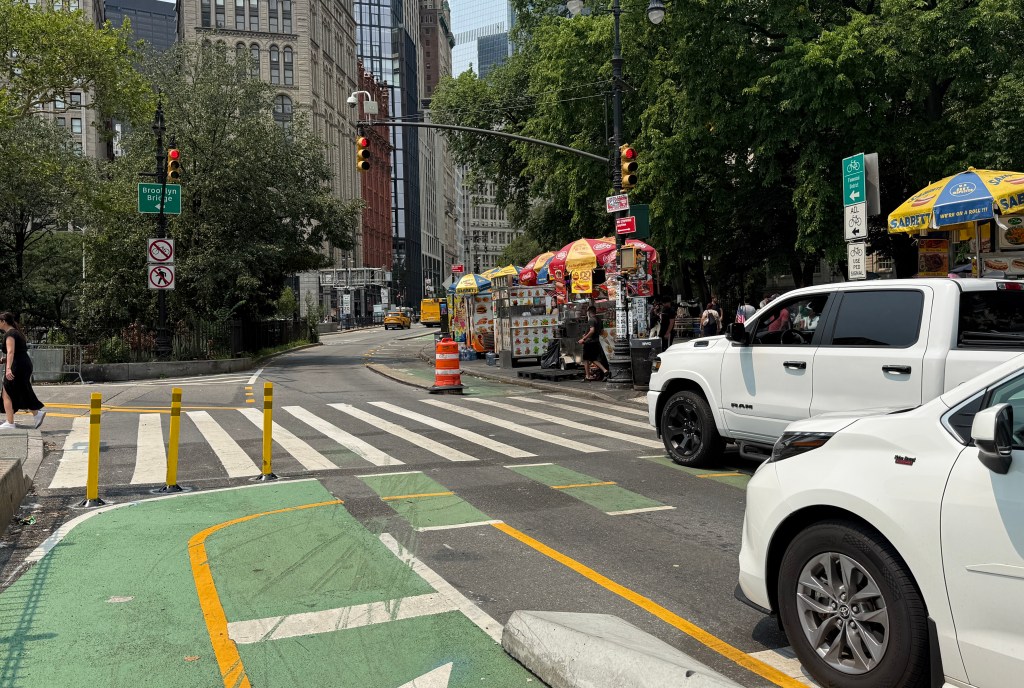
The space for cars on Centre Street has been reduced from two lanes and a parking lane to one lane and a cross-hatched no-standing zone, but congestion caused by cars — especially those moving and parking illegally — persists.
When Streetsblog visited, a driver had parked his truck in the bike crosswalk that would’ve allowed for a moderately smooth transition from the east-side to the west-side lane. It’s not the first time the driver has parked dangerously, as the truck’s plates showed almost 30 parking violations, according to city records.
Lingering flaws
Cyclists that continue north past the bike-only intersection, almost immediately hit the intersection of Centre and Chamber streets, where Streetsblog ran into a blip in the original design. The bike lane just barely juts out into a pedestrian sidewalk crossing Centre Street, and pedestrians are regularly using it as a crossing island, standing directly in the path of the bike lane, endangering both walkers and cyclists.
And the turn from the bike lane onto the new southbound lane, and vice-versa, is very sharp. It’s a turn that confuses first-time riders.
“This makes no sense,” said Sergio Guerrero, who accidentally ended up at the intersection of Centre and Chambers streets, past the hairpin turn around, instead of on the Brooklyn Bridge bike path, where he was headed.
Jacobi said that the minimal signage should be expanded, in order to lend a hand to those first time riders. “For a design that’s a little bit flawed and imperfect, not having any of that way finding makes it a challenge.”
Jacobi said that the bridge’s bike path would benefit from more connections between other greenways in Manhattan. Notably, the bike path isn’t connected to the widely popular Hudson River Greenway, even after calls from cyclists to install a connecting lane on Chambers Street.
“We’re still sort of lacking that safe route to the west-side,” she said. “We’ve seen the city stalling on getting those connector bike lanes, getting people to greenways, which is a lot of what people are biking over the bridge to do.”

Read More:
Streetsblog has migrated to a new comment system. New commenters can register directly in the comments section of any article. Returning commenters: your previous comments and display name have been preserved, but you'll need to reclaim your account by clicking "Forgot your password?" on the sign-in form, entering your email, and following the verification link to set a new password — this is required because passwords could not be carried over during the migration. For questions, contact tips@streetsblog.org.