OPINION: Slow Down on Our Bike Paths!
From time to time, Streetsblog invites leading thinkers in the livable streets movement to opine on safety concerns. Our instinct toward free debate should not be interpreted as approval for one opinion or another.
The Editors
Social critic Ivan Illich once observed that when machines exceed 15 mph, they degrade “the basic pattern” of our public spaces.
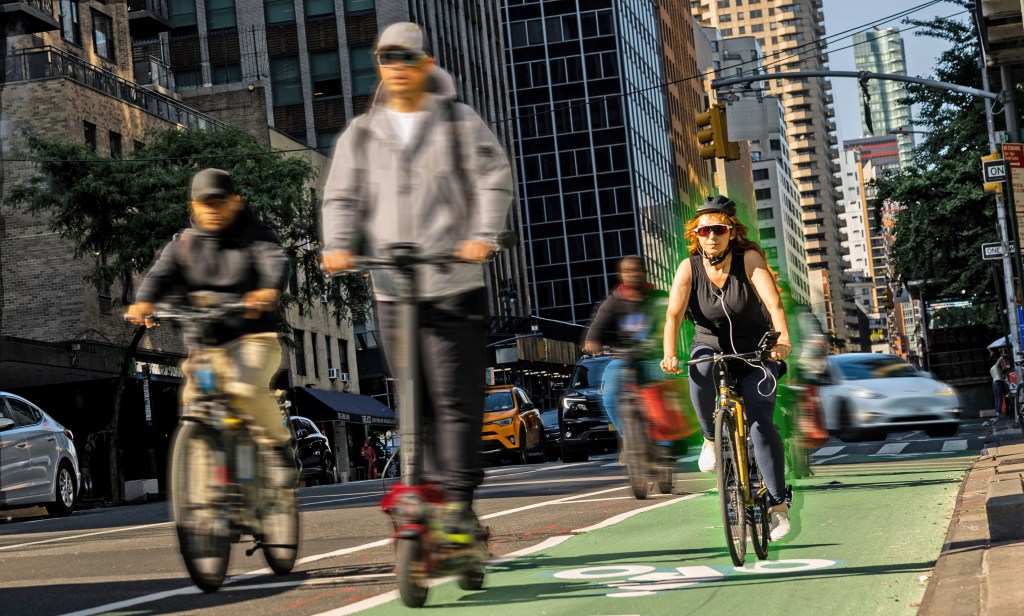
That’s how I would describe what our bike lanes feel like right now: degraded public space.
This “degradation” is not just a question of injury statistics, which show that electric micromobility causes only a small percentage of street injuries. According to the city, e-bikes, stand-up scooters, and mopeds account for 1.8 percent of the 449 pedestrian fatalities between 2020 to 2023, and roughly 4.5 percent of the 28,450 pedestrian injuries over the same period (in other words, car and truck drivers caused 98 percent of fatalities, and 96 percent of injuries). But, while relatively small, they have increased over that time period as users of mopeds and e-bikes have risen.
So, yes, cars and trucks are far more dangerous, but that assertion does little to address the day-to-day experience of walking and biking in the city. Like other transportation advocates, I have long argued that our bicycle lanes and protected paths should be pleasant places where all riders, including first-timers, seniors and children, feel safe.
But when even experienced riders say they’ve stopped riding because of high-speed two-wheeled motorized vehicles, the canary in the coal mine is long deceased.
Some people, such as members of the E-Vehicle Safety Alliance, say all electric vehicles, regardless of speed, should require licenses and registrations. And it’s easy for us to dismiss such groups for championing only this unworkable and counterproductive regime when they object to so many proven safe street measures, such as congestion pricing and protected bicycle lanes.
But clearly something must be done, and as safety advocates, our obligation is to bring solutions instead of just rejecting the Council’s e-bike registration bill. And solutions abound: a real government response to the app delivery companies whose requirements for rapid delivery have contributed to this problem; wider bicycle paths; the creation of the Department of Sustainable Delivery; crackdowns on illegal vendors and unsafe equipment and measures to address “reckless driving” (mentioned in Brad Lander’s micromobility plan); adoption of Charles Komanoff’s proposed distance surcharge for deliveries to discourage people from ordering food from restaurants halfway across town.
I have another recommendation: a speed guideline in bike lanes.
Street-safety activists have long advocated that “20 is plenty” for cars. And as the city finally employs its state-given power to lower roadway speeds, it should also begin to lower speed recommendations for bike lanes, which should be lower than those for cars on roads.
Many European cities have a safe speed of 25 kilometers per hour (15.5 miles per hour) for bike paths in congested areas. Even bike-friendly Amsterdam has a pilot for a 12-mph speed limit on bicycle paths in congested areas. An Amsterdam traffic official recently echoed something I hear every day in New York: “More and more Amsterdam residents, young and old, no longer dare to cycle in the city. … Due to the rapid rise of various electric bicycles, it is now more necessary to make room on the cycle path for people who drive slower.”
New York City’s Department of Transportation should start by adopting and promoting a safe speed guideline of 15 mph rather than its current guideline that a safe speed is “under 20 mph.” And the DOT should also post signs, especially in our most congested areas, that a safe speed is 15 mph and change the recommendation on its bicycle map. This will apply to all devices that are currently legal in bike lanes: fast analog cyclists, electric bike riders, users of stand-up e-scooters.
Basic engineering can fix some problems immediately. The Citi Bike e-bike is a wonderful tool to reduce car dependency, and its top speed has been reduced from 20 to 18 mph. Now, Lyft needs to go further: 15 mph is better and mirrors the top speed for e-bikes in bike share programs around the world.
This is New York City — not Europe — and we are not rule followers. So, I can already hear snorting over signs declaring that a safe speed is 15 mph. Some will ignore it, but guidance can be a first step. We may have to consider some kind of enforcement later, but let’s begin by trying to change the culture — and repairing the social degradation against which Illich so eloquently warned.

Read More:
Streetsblog has migrated to a new comment system. New commenters can register directly in the comments section of any article. Returning commenters: your previous comments and display name have been preserved, but you'll need to reclaim your account by clicking "Forgot your password?" on the sign-in form, entering your email, and following the verification link to set a new password — this is required because passwords could not be carried over during the migration. For questions, contact tips@streetsblog.org.