Boston Makes Its Bus Lane Experiment Permanent

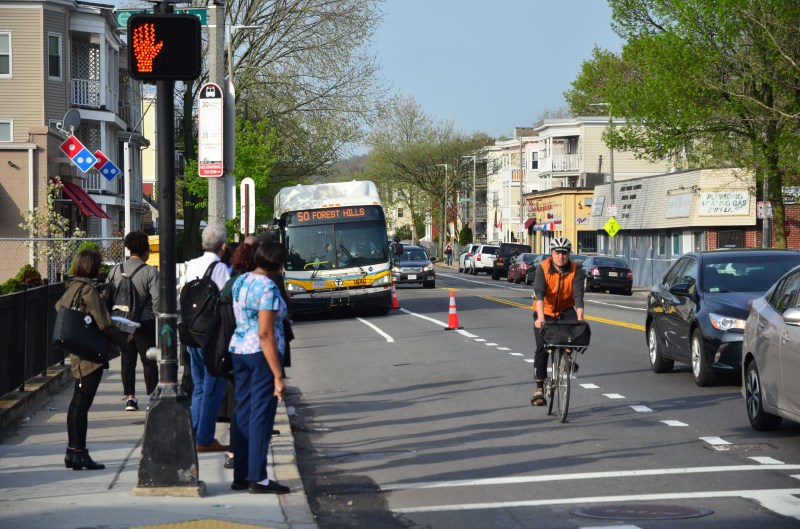
It doesn’t take much money to make riding the bus a lot more convenient. With little more than orange cones, Boston set up a bus lane on one of its most important but congested bus corridors — and it worked wonders.
At first, the city let the one-month bus lane experiment on Washington Street expire, frustrating bus riders and advocates who expected the test run to transition seamlessly to a permanent improvement.
But the administration of Mayor Marty Walsh quickly came around and announced yesterday that the bus lane will be back beginning June 18. The city won’t wait for permanent markings and signage to reinstitute bus priority each weekday morning from 5 a.m. to 9 p.m.
The bus lane speeds up trips for six bus routes carrying 19,000 daily trips on Washington Street in the Roslindale neighborhood, connecting to the Forest Hills Orange Line Station. Previously, the curb lane was reserved for parked cars during rush hours and buses operated at a snail’s pace in general traffic, weaving in and out of rush-hour congestion at every stop.
Beginning in early May, the city converted a parking lane during the morning rush hour to a buses-and-bikes-only lane using orange cones. Bus riders and cyclists got a taste for how much better their commute could be.
During the most congested hour (7:30 to 8:30 a.m.), when about 1,100 bus riders travel the corridor, bus travel times dropped 20 to 25 percent, the city reports.
According to survey data from the City of Boston, 94 percent of bike and bus riders said they wanted the pilot made permanent.
Andrew McFarland of the advocacy group LivableStreets Boston hopes to see that success replicated elsewhere. Boston has identified a number of other streets as high-impact locations for dedicated bus lanes.
“This is all the more reason the city should looking at the other four or five corridors that are really congested,” McFarland said.

Streetsblog has migrated to a new comment system. New commenters can register directly in the comments section of any article. Returning commenters: your previous comments and display name have been preserved, but you'll need to reclaim your account by clicking "Forgot your password?" on the sign-in form, entering your email, and following the verification link to set a new password — this is required because passwords could not be carried over during the migration. For questions, contact tips@streetsblog.org.