An Impressive New Bike Connection Highlights Changing Attitudes in Cleveland

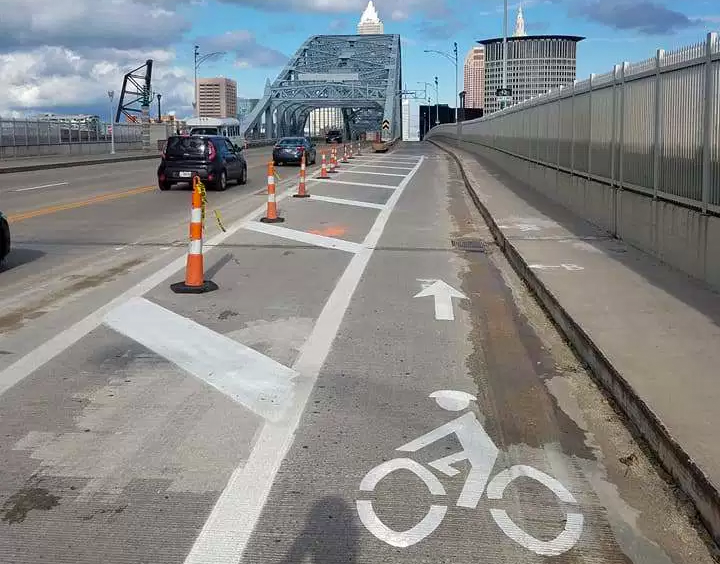
The route between downtown Cleveland and Ohio City has always been a bit harrowing on a bicycle.
Trucks and buses roar by right next to the painted bike lane. And just as you ascend the Detroit-Superior Bridge going eastbound, the bike lane vanishes into the curb.
At least that’s how it was until this week. Now, people on bikes finally have some space of their own on this side of the bridge: The outer eastbound lane is being converted into a bike lane. (The westbound side already had a continuous bike lane, though it leaves a lot to be desired.)
The bridge spans a section of the Cuyahoga River known as Industrial Valley, linking downtown Cleveland to two thriving retail districts and two large public housing complexes. There’s a lot of biking and walking traffic on the bridge, and one of the advantages of the new bike lane is that it also gives pedestrians on the south side more of a buffer from high speed traffic.
Parts of the bike lane will be separated from traffic by plastic bollards, and conflict points with will be treated with green paint. The intersections at the ends of the bridge will even have two-stage turning boxes and bike signals — all firsts for Cleveland, which has been resistant to adopt bike infrastructure treatments that are quickly becoming standard in other American cities.
For the city’s cyclists, it’s the happy ending to a long saga.
Bike advocates began pressing for access across the bridge 16 years ago, but they were overpowered by trucking interests who did business in Industrial Valley. They also had to contend with city transportation staff that have resisted modern ideas about bike infrastructure.

But recently, whether due to political pressure, soul-searching, or some other cause, that resistance seems to have softened. With this project, Cleveland proved it could implement good bike infrastructure. The whole project cost just $81,000.
“The times have changed and people kind of see the value of having a bridge lane that accommodates all users,” said Jacob VanSickle, executive director of Bike Cleveland. (Disclosure: My husband is president of the board and I am a former board member.)
VanSickle says the recent push started after the latest incident in the long history of bike crashes or scary close calls on the bridge. The City Councilman representing the area at the time, Joe Cimperman, called a meeting with ODOT and city leaders to discuss how it could be improved.
ODOT signaled openness to redesigning the bridge somehow. So the city applied for a planning grant from the metropolitan planning organization, NOACA.
One smart thing advocates did was to use a construction project to test their proposal. The outer lane of the bridge had to be closed for unrelated repairs for some time last summer. A camera was mounted on a nearby building to monitor traffic.
“Traffic didn’t back up as much as people had anticipated,” said VanSickle. Advocates could point to that when they made their case to city staff and ODOT.
City traffic engineer Andy Cross doesn’t have a reputation for embracing bike projects, but he got on board in a big way, VanSickle says.
“Andy said he hasn’t had a lot of time to work on other streets because he’s been working so much on the Detroit-Superior Bridge project,” VanSickle said.
It’s a testament to recent shifts at the city and at NOACA, where engineer Melissa Thompson helped lead the planning, that the project was completed so swiftly.
“The city just said they wanted to get it done this year,” VanSickle said.

Streetsblog has migrated to a new comment system. New commenters can register directly in the comments section of any article. Returning commenters: your previous comments and display name have been preserved, but you'll need to reclaim your account by clicking "Forgot your password?" on the sign-in form, entering your email, and following the verification link to set a new password — this is required because passwords could not be carried over during the migration. For questions, contact tips@streetsblog.org.