The Mayor of Portland Is Cheerleading for a Highway Expansion

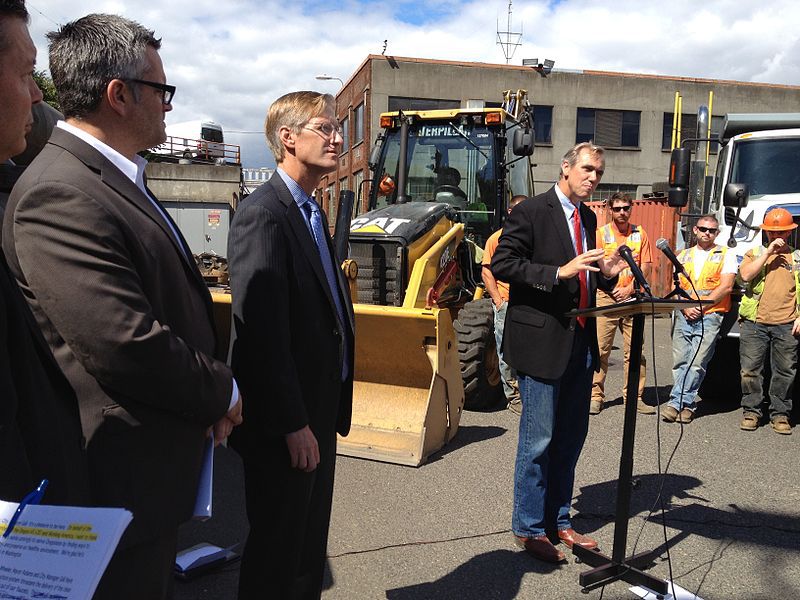
Ted Wheeler, the mayor of Portland, came out swinging last week against residents who are trying to stop a $450 million widening of I-5 in the Rose Quarter. For a city with a legacy of successful freeway revolts and a reputation as a national leader on sustainable transportation, it’s a surprising turn to watch the mayor go full-on highway booster.
Wheeler defended the highway widening in an interview on Oregon Public Broadcasting last week. He relied on a few rhetorical tricks that observers may recognize from other highway fights, like the I-70 widening in Denver. Identifying and picking apart these talking points is an essential exercise if you want to stop these highway projects and the traffic and pollution they cause.
Fortunately, Jonathan Maus at Bike Portland quickly rebutted Wheeler’s claims. Here’s a review of three major arguments from Wheeler and Maus’s response:
Hey, this freeway expansion is no big deal.
Wheeler said:
The narrative that’s out there right now that this is somehow a mega-project is sort of ridiculous. What we’re really talking about here is a quarter of a mile, two auxiliary lanes through the Rose Quarter to make the merge safer.
While the new lanes won’t add a huge amount of mileage, there’s no doubt that the project will add car capacity in the heart of the city. And Maus points out that the $450 million price tag certainly meets the legal definition of a mega project:
He says calling this a mega-project is “ridiculous,” yet at an estimated $450 million it’s $110 million more than the statutory definition of a mega-project as defined in Oregon law as per House Bill 2017, Section 121 (1) (on page 108).
That’s $450 million on road expansion instead of transit or safer biking and walking on local streets.
We need to expand this freeway to improve walking and biking.
In addition to more freeway lanes, the project calls for decking over small sections of I-5. These lids are a big component of Wheeler’s pitch:
If somebody came to me and said, ‘Hey Ted, do you want to spend half a billion on a freeway expansion?’ I’d say ‘No’ and ‘Hell no!’ But that’s not what this is. This is about reconnecting a community. It’s about bike, it’s about ped, it’s about transit, it’s about safety.”
Maus replies:
It’s unclear how two relatively small lids over the freeway will “reconnect the street grid for the historic Albina community.” ODOT has only described them as having vegetation and a former Portland Parks Bureau director said last week they’re likely to be “more of a liability than an amenity.” At City Council yesterday, one of Wheeler’s invited guests, Portland architect Matthew Arnold, testified that, “In my opinion those lids should be much larger if you really want to promote that kind of continuous urbanism.”
He referred to the two freeway lids as, “mostly a bicycle and pedestrian play.” That use of the word “play” sounds like an acknowledgment that they were included in the project purely as a way to curry favor with active transportation advocates. Merriam Webster defines that use of the word as a “a move or series of moves calculated to arouse friendly feelings.”
This freeway expansion is really about helping a historic black neighborhood.
Wheeler said:
It actually restores the very neighborhood that was the most impacted by the development of I-5 and that’s the historic African American Albina community. And that’s why people who have testified on this — who have testified overwhelmingly in favor of this — tend to be people from communities of color who understand that history.
Maus replies:
The mayor’s reference to people of color testifying “overwhelmingly in favor” of the project is confusing. At the September 7th public hearing only four people (out of about 17 total) testified in favor of the project. Two of them were ODOT staffers (Shelli Romero and Andrew Plambeck), one was an invited Portland Planning Commissioner (Andre Baugh), and only one was an independent citizen (Terry Dublinski-Milton, who is white). Asked to clarify the mayor’s statement, his office said, “[At the September 7th hearing] handful of people of color testified and the majority of folks testified in support of the project which was in stark contrast to the people who testified in opposition. The evidence is in the recording of the council session.”
This is the playbook for pushing through urban highway expansions in the 21st Century: Add some window dressing and claim it’s good for walking, biking, transit, and city residents. If Portland falls for this, which other cities will too?
More recommended reading today: Los Alamos Bikes corrects a local reporter who blamed pedestrians for their own deaths. And Transportation for America has an update on autonomous vehicle legislation in the Senate, which is shaping up as a “giveaway” to car companies.

Read More:
Streetsblog has migrated to a new comment system. New commenters can register directly in the comments section of any article. Returning commenters: your previous comments and display name have been preserved, but you'll need to reclaim your account by clicking "Forgot your password?" on the sign-in form, entering your email, and following the verification link to set a new password — this is required because passwords could not be carried over during the migration. For questions, contact tips@streetsblog.org.