As Fewer Kids Attend Neighborhood Schools, Transportation Challenges Mount

The more kids get driven to school instead of walking, the more chaotic the drop-offs and pick-ups become. Twice a day, the streets around schools turn into a snarled traffic mess, with a lot of vulnerable children walking around.
There’s a discussion at Greater Greater Washington about how schools can make the process safer and less of a free-for-all, and few seem to have had much success.
GGW’s Matthew Kohler notes that the rise of school choice policies adds a whole new wrinkle, as students shift from neighborhood schools within walking distance to schools farther away:
The problem’s scope has only recently expanded — in other words, it’s not something schools have had that much time to think about.
Since the mid 2000s, enrollment at both charter and traditional schools is up (charters had 44 percent of citywide enrollment in 2014), and with more parents entering the school lottery every year more students are attending schools outside of their neighborhoods. That often means walking or biking isn’t feasible (especially for elementary school kids who may not be old enough to walk, bike, or take public transportation), so more parents are driving.
In other words, said Steve Glazerman, “school choice does naturally lead to longer commutes, all things equal, at least in the short run. The idea is that parents get to trade off distance with other school attributes like academic quality or special programs.”
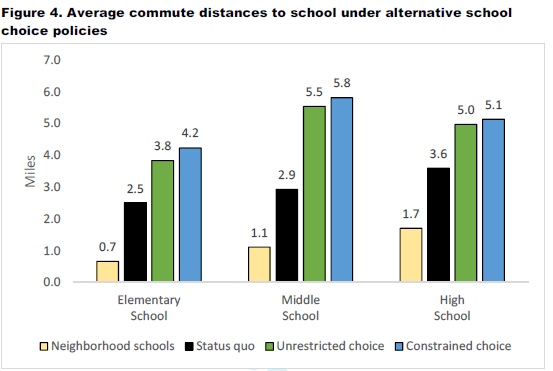
Steve actually did a recent study on school choice, and his findings helped lead to this graph, which is based on data from everyone who applied to DC’s public school lottery in 2014.

“School choice,” said Steve, “both charters and open enrollment, more than double the average commute distance for these families, probably pushing a lot across the mode choice threshold from walking to car/bus/train.”
More recommended reading today: Transportation for America warns that transit funding will be at risk in the Trump budget. And Price Tags considers how much ride-hailing companies like Uber and Lyft are increasing traffic in Seattle.

Read More:
Streetsblog has migrated to a new comment system. New commenters can register directly in the comments section of any article. Returning commenters: your previous comments and display name have been preserved, but you'll need to reclaim your account by clicking "Forgot your password?" on the sign-in form, entering your email, and following the verification link to set a new password — this is required because passwords could not be carried over during the migration. For questions, contact tips@streetsblog.org.