Tree-Mendous: City Officials Must Do More To Create Shady Conditions As Temps Soar
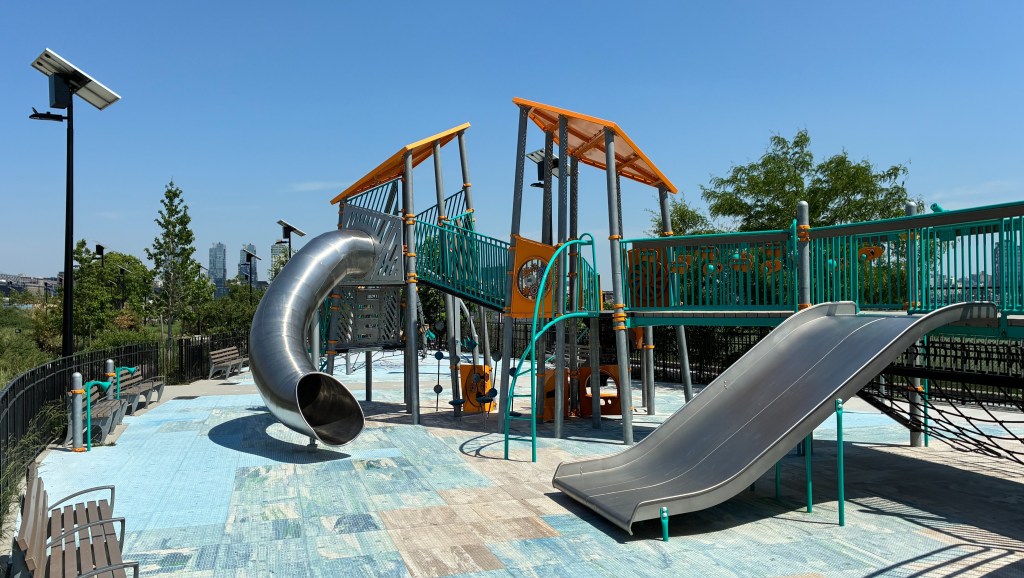
On May 19, I walked down to Pier 42, a former industrial pier on the Lower East Side that the city transformed into an eight-acre waterfront park. New York was entering a heat wave, and I wanted to measure the temperature’s effects on the park’s playground.
I knew the playground would be hot. It is bereft of trees, unshaded and covered in rubber surfacing. The swings, slides and climbing structures are fully exposed to the sun. But I didn’t expect the park to be hotter than the rest of the neighborhood, and I didn’t expect it to pose such a threat to public health.
I used a heat stress sensor to record the conditions. Inside the playground, the air temperature climbed to 100 degrees, far above the city’s official high that day of 93 degrees. The heat index topped out at 129 degrees, which the National Weather Service classifies as “extreme danger” and “heat stroke highly likely.”
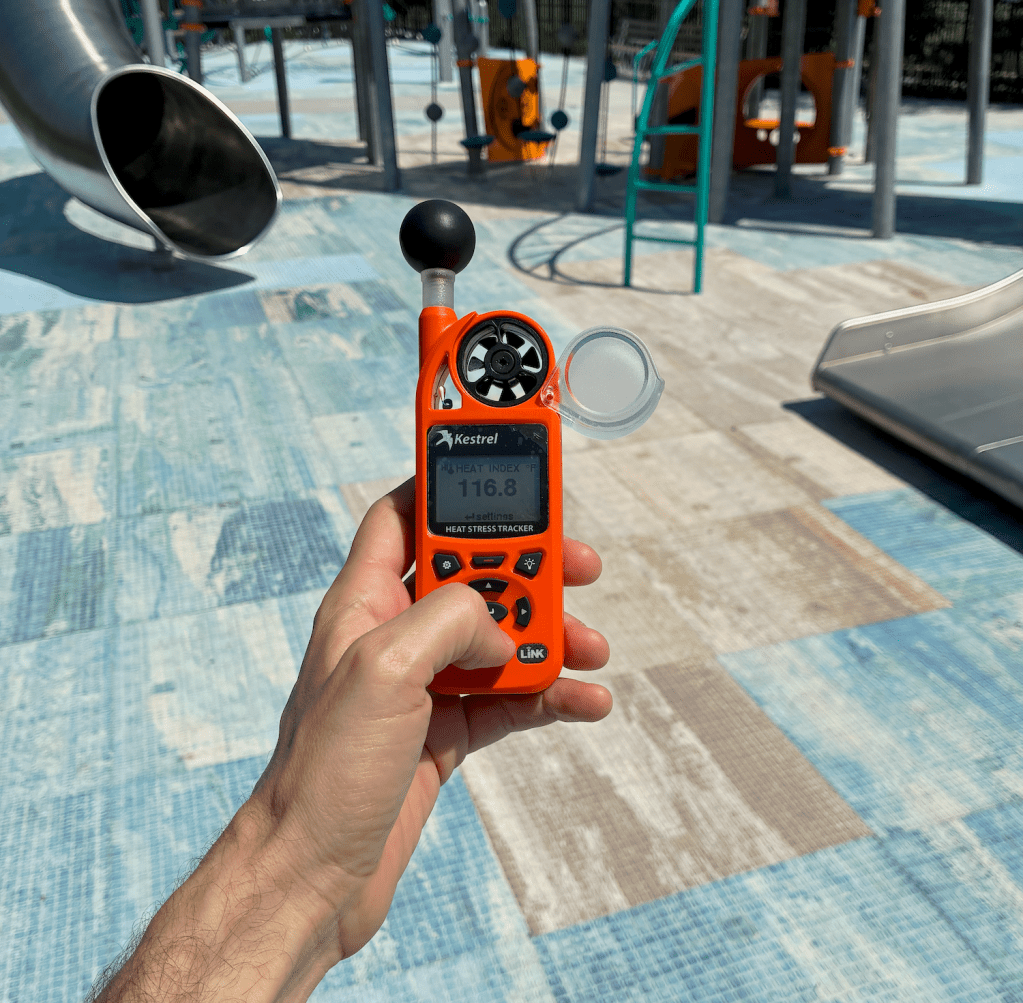
And the wet-bulb globe temperature — a comprehensive heat stress metric that accounts for radiant heat in sunlight and surrounding surfaces — notched just below 95 degrees. No outdoor activity is safe at such a temperature. Not for the fittest U.S. Army recruits, not the world’s top athletes, and especially not for children or their caretakers.
These measurements are especially galling because the city designed Pier 42 as a climate change adaptation project. It belongs to the larger East Side Coastal Resiliency Project, New York’s ambitious effort to protect Lower Manhattan from floods and hurricanes. City and federal leaders spent a lot of time, money and manpower to defend the neighborhood from storm surges and rising seas.
But, apparently, none of them planned to abate New York’s more common and lethal threat of extreme heat. In fact, Pier 42’s playground only made the heat worse.
When I posted about the playground on X, a number of commenters characterized the heat as a minor inconvenience or a youthful rite of passage. They had grown up in the 1970s, played on burning hot monkey bars and metal slides, and turned out fine.
But the climate in which they came of age no longer exists. New York City already records more 90-degree days than it did back then. In the near future, the city could easily face two months of dangerous heat, every year. More warm spring days, combined with unshaded metal slides, will cause second-degree burns. Extreme heat is becoming an annual fact of life in New York. It is arriving earlier, lasting longer and bearing down hardest on those who don’t have cooling, indoors and out.
Heat is America’s number-one weather-related killer. It weakens the body both quickly and over time. It’s fiercest in cities, where many families don’t have backyards, and where children, who are especially vulnerable to heat, rely on neighborhood parks for outdoor play.
Children can’t regulate their temperatures as well as adults. In a heat wave, they are more likely to suffer heat illness, causing respiratory and kidney disease and impairing cognitive function. Their thinner skin makes them more susceptible to contact burns.
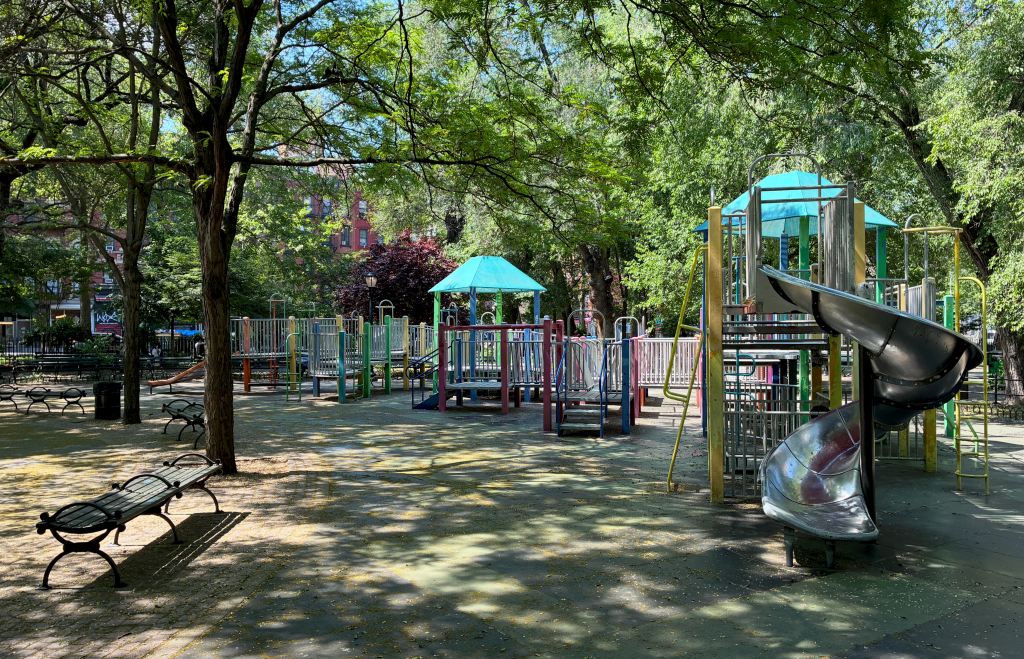
Astonishingly, some New Yorkers do not consider this a real problem. They think that if Pier 42 is too hot, people simply shouldn’t go there. They point out that Lower East Siders have other green spaces such as Seward Park, a cooler, leafier and older green space a mile away, where I recorded safe and comfortable temperatures that same afternoon.
But new parks exist for good reasons. They expand access to recreation, and create more opportunities for social interaction, physical fitness and overall well-being. Families that can’t afford air conditioning need somewhere safe outside to cool down. And those who can afford AC often prefer a pleasant alternative to spending the day inside.
Furthermore, this park was not a gift to the city. It cost $34 million in taxpayer money. The idea that New Yorkers should not expect to enjoy the outdoor spaces we pay for is ridiculous on its face.
Pier 42’s playground is unacceptably hot for several predictable reasons. Many of them come down to engineering.
Before the playground opened, the city needed to rebuild Pier 42 to mitigate flooding and improve drainage. This process required the installation of an underground sewer beneath the area that became the playground’s north edge. According to a spokesperson for Mathews Nielsen Landscape Architecture, which designed the park, the resulting easements limited the number of canopy trees that could be planted around the play areas.
As a consequence, the playground has very little leafy shade beyond a smattering of trees inside the grounds and a grove clustered along its south edge. In 10 or 15 years, these trees may offer shade in the shoulder seasons, when the sun is closer to the horizon. But they will never form an overhead canopy in the middle of summer.
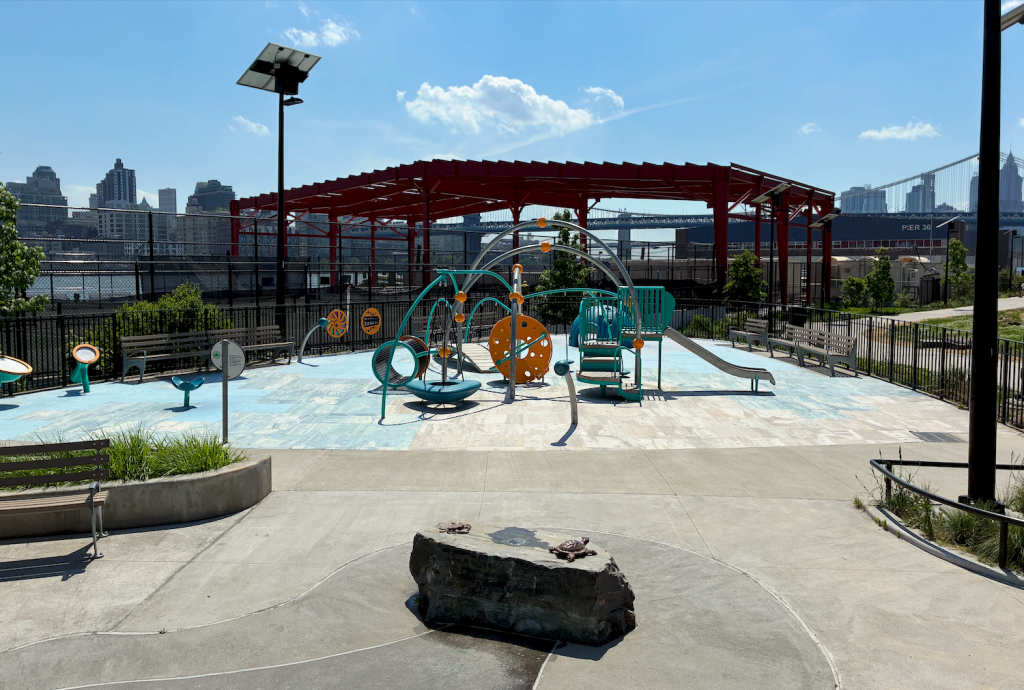
The playground also obeys a long list of safety standards, none of which account for the unintended consequences of heat. Modern playgrounds require clear areas, called “fall zones,” that limit the placement of trees inside play areas. They tend to feature rubber surfacing, to cushion children from falls, and metal slides, to avoid the maintenance headaches of plastic alternatives.
These constraints are challenging but surmountable. The bigger issue is that New York City gives little consideration to shade and cooling when designing new parks such as Pier 42. If its architects had treated heat mitigation as a crucial design goal, Pier 42 could have featured shade on opening day.
It’s not hard for New York City to budget for this when it’s building new playgrounds and refurbishing older ones.
The cheapest, most straightforward and practical solution for big city heat is more shade. Sails and structures don’t cool the air the way trees do, but for human protection and play equipment, they are just as effective. Cities that deal with year-round heat, like Miami and Los Angeles, already understand this. In Phoenix, large, tent-like canopies are a common sight.
New York already uses structural shade, just inconsistently. The beige fabric sails over the sandboxes at Harmony Playground in Prospect Park are one example. The elegant wood and steel pergola at Pier 5 in Brooklyn Bridge Park is another. The structure is sturdy enough to withstand a windy pier environment, with footings placed outside the play area’s fall zones.
A press officer for the Parks Department told me the agency is looking into shade solutions for Pier 42. But I shouldn’t have to wait for my son to get burned or file a lawsuit, as other parents have, to get a usable playground.
In many ways, New York is a climate leader. But adaptation cannot mean preparing only for the spectacular disasters of floods and hurricanes. If the city is serious about adapting to climate change, it needs to design public spaces not just for the next storm, but also for the next hot day.

Read More:
Streetsblog has migrated to a new comment system. New commenters can register directly in the comments section of any article. Returning commenters: your previous comments and display name have been preserved, but you'll need to reclaim your account by clicking "Forgot your password?" on the sign-in form, entering your email, and following the verification link to set a new password — this is required because passwords could not be carried over during the migration. For questions, contact tips@streetsblog.org.