How Much Will New Yorkers Pay For Trump’s Penn Station Redevelopment Scheme?
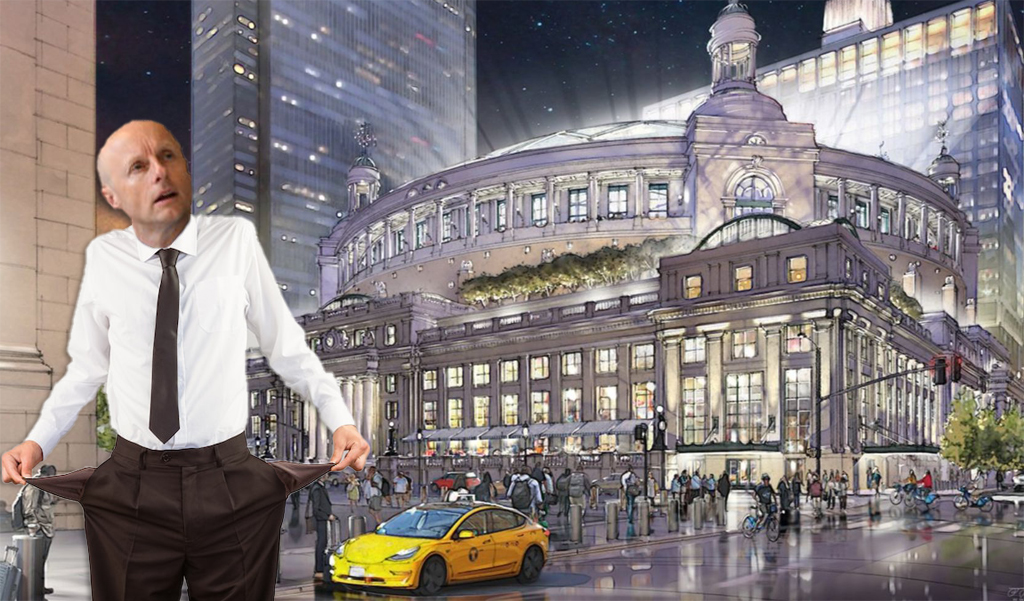
New Yorkers could wind up paying twice for the new Penn Station: once when Amtrak comes asking for money and then when a private developer makes their money back from the project.
Streetsblog provides high-quality journalism and analysis for free — which is something to be celebrated in an era of paywalls. Once a year, we ask for your tax-deductible donations to support our reporters and editors as they advance the movement to end car dependency in our communities.
If you already support our work, thank you! If not, can we ask for your help?This year's fundraiser includes a special gift for our biggest supporters. Don't miss out.
Together, we can create a more livable, walkable, bikeable, equitable and enjoyable city for all. Happy holidays from the Streetsblog team!
Will the dollars make sense?
Andy Byford, who's in charge of the federal effort to build a new Penn Station, has shed a small amount of light on how the project is going to be paid for, but the math on the project suggests that New Yorkers will pay for the project one way or the other even though Amtrak seized control of the redevelopment project.
The plan relies on Amtrak hiring a private developer to design, build, operate and finance the project. It's unclear right now how much the private developer will put up — since Byford has shied away from revealing the full price tag because he says he wants to see what developers come back with after Amtrak issues a request for proposals.
"Imagine, say, the project was $5 billion," Byford last week told the Permanent Citizens Advisory Committee to the MTA in a meeting. "If we can raise $4 billion from grants, from loans, from states, from the feds, from the city," it would still leave a gap of $1 billion for a private developer to fill.
The price tag is more likely much closer to $8 billion.
Byford's stated aims of creating a single-level concourse and improving the train operations by introducing some wider platforms have both had price tags attached to them for some time now. An internal report commissioned by the MTA in 2020 pegged the cost of a basic single-level refurbishment of Penn Station at about $5.7 billion in current dollars. And a 2021 study on through running commissioned by Amtrak, the MTA and New Jersey Transit found that it would cost $3.6 billion (again, current dollars) to widen the middle platforms in the train station, which would allow for some extra trains to run through the station.
Additionally, we know that if Byford and Amtrak pursued a grand entrance to the train station on Eighth Avenue, it would add $2 billion to the price tag to both build the entrance and to pay MSG owner James Dolan for the right to demolish the Hulu Theater (which old-timers know as the Felt Forum).
So whatever portion of the $8 billion that governments fail to fund will be funded by the developer.
"There will be a hefty public sector funding element, but that will be topped up by some upfront funding from a master developer who will thereby have skin in the game to get it done and get it done properly and get it done on budget," he said at the meeting last week.
And that developer is going to want to recoup. How?
One possibility is that riders could wind up paying for the project in the form of ticket surcharges or just large annual payments to the developer by the tenant railroads at Penn Station. In 2023, conglomerate ASTM made a pitchfor a privately financed Penn reconstruction. Once the work was finished, Amtrak, the MTA and NJ Transit would have paid $250 million to ASTM every year for 50 years, or $12.5 billion.
After Streetsblog began reporting on the possibility of a half-century of payments, Byford confronted the user fee question at his recent appearance, telling the assembled machers that he would "not recommend any option to the Amtrak board that is unaffordable, or that saddles the railroads and New Yorkers with unaffordable debt," though it's not clear what he would consider unaffordable.
So if ticket surcharges or annual rent payments turn out to be a non-starter, there's another trap to look out for: using real estate development and redirected property taxes to cover the bill. If that sounds familiar, it's because that's how previous Gov. Andrew Cuomo and now-Gov. Hochul would have paid for their version of a Penn Station reconstruction and expansion — a state land-use process known as a General Project Plan.
Under the terms of the Penn GPP, the Penn project would have been funded by letting real estate behemoth Vornado build office towers, and instead of paying traditional property taxes, using "payments in lieu of taxes" or PILOTs to support bonds that paid for construction.
One analysis of that plan showed that New York City would lose over $1 billion in property tax revenue over 20 years thanks to tax breaks given to Vornado. The idea for the value capture plan collapsed in the face of a soft market for office space in the wake of the Covid pandemic, and Hochul even announced at one point that she had "decoupled" the zoning plan from the effort to rebuild Penn.
But the idea is still clearly alive for some people. Gothamist has reported that Vornado CEO Steven Roth is directly working with one of the groups preparing a bid for the Penn project.
Government watchdogs are wary of both user fees or a GPP scenario.
"Private finance means local 'users' or the local tax base will pay a portion of the costs of an Amtrak project that may or may not make sense for New York," said Reinvent Albany Executive Director John Kaehny.
Kaehny called the various proposals a "private finance scheme" that offer New York two bad choices: either "ticket surcharges on MTA and NJT passengers" or "billions in future property taxes from the Vornado/GPP area diverted to Amtrak."
There's also the issue of the state money that Byford floated as a possibility. Kind of famously, Transportation Secretary Sean Duffy took the Penn Station reconstruction project away from the MTA back in April. Gov. Hochul shrugged — and subsequently took $1 billion in state funding for the project and redirected it to other transit needs.
Asked about Byford's invocation of state money, Hochul's office did not sound eager to dig up another billion.
"The governor successfully secured full responsibility from federal partners to take the lead on delivering a beautiful, modern Penn Station," said Hochul spokesperson Sean Butler. "Part of that responsibility involves financing the project, allowing the state to reallocate over $1 billion to other critical projects. It is now up to the federal government to propose a sustainable and appropriate model to fund Penn reconstruction."
Byford is right that the public sector has never figured out how to pay for a new Penn Station, but it's not fair, experts said, to blame New York State, which is more financially constrained than the federal government.
It's no question that the federal government, with its $7 trillion budget can pay for a $8-billion capital project like Penn Station. The question is whether it wants to.
"The United States is bailing out a libertarian fiasco in Argentina," said Riders Alliance Director of Policy and Communications Danny Pearlstein. "Of course the federal government can afford a new Penn."
Dave Colon is a reporter from Long Beach, a barrier island off of the coast of Long Island that you can bike to from the city. It’s a real nice ride. He’s previously been the editor of Brokelyn, a reporter at Gothamist, a freelance reporter and delivered freshly baked bread by bike.
Residents of Lower Manhattan have been demanding pedestrianized streets for decades, but the city and Big Business keep thwarting them. Sounds like a job for Mayor Mamdani.